

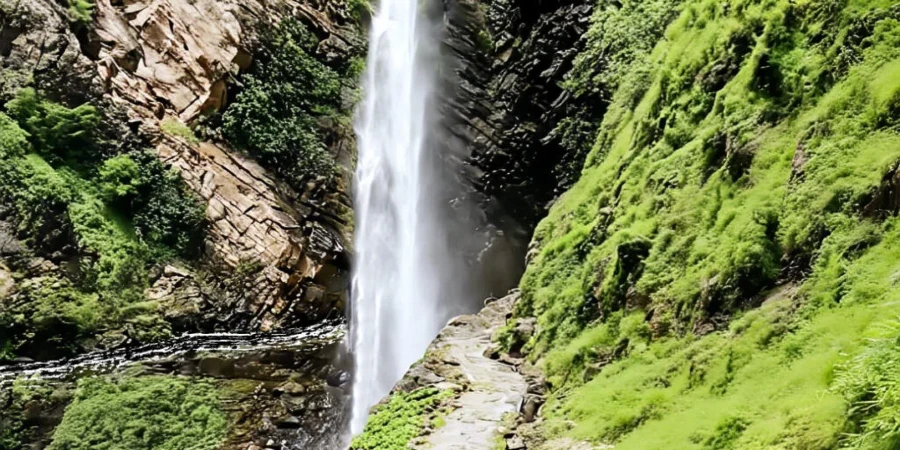
Moreover, the story of the waterfall in Chineshwar is highly dependent on the cultural and spiritual background of the region of Champawat. The legends refer to the place surrounding the waterfall, which was used by holy men for their meditation, as it was quiet and secluded. It is also said that the temple of Chineshwar Mahadev was constructed several years ago in the traditional Himalayan architectural style and is a very old one. Visitors, especially during the Mahashivratri festival, come in large numbers from villages and towns around to visit the temple and the waterfall to get the blessings of lord Shiva. Today, Chineshwar Waterfall is becoming more and more popular with the public, mainly trekkers and offbeat travellers, through whom the news about it has spread. The journey to the waterfall is somewhat difficult; you have to go through the forests of the trees that are curved and blossomed with flowers, and also view all along the path. In addition, this place has a lot of birds and butterflies that are very attractive to visitors. In fact, Chineshwar Waterfall is one of those that are different from other waterfalls that have been commercialised, as it preserves its nature in the purest and original way, intact and not spoiled by people.Around the fall, there is a huge silence which is only interrupted by the noise produced by the water that is falling from a height of the cliff, and that silence has a great uplifting power on a person’s body and soul and can be considered a kind of meditation. So, whatever may be your position: a devotee, a lover of nature, or a seeker of peace among the vast crowds, you will get your perfect share at Chineshwar Waterfall, which is a mixture of spirituality and wild nature and ranks among the most exclusive of Uttarakhand’s hidden gems.Nearby Places to Visit near Chineshwar Waterfall, UttarakhandLohaghat: Lohaghat is an absolutely charming small town of the hill area which is only 10 km away from the Chineshwar Waterfall and is located on the banks of the Lohawati River. Felt with the vibe of the peaceful nature and the by-gone era, Lohaghat is a perfect combination of pine and oak trees. People who love to do nature walks, visiting temples and seeing mountains will be delighted. In addition, the town also serves as a door to the discovery of many historical and natural landmarks of the Champawat district.Abbott Mount: Located around 15 km from the destination, Abbott Mount is a cozy and alluring one of the well-known hill stations and it owes its name to John Harold Abbott, a British businessman who developed it during the colonial era. Due to its height of 6,400 ft, the station offers great views of the snow-covered Himalayan ranges. Besides, the station has ancient British-style houses that are mixed with the fog-covered trails and the tranquility of the place thus the station is very popular among the writers, photographers and peace seekers.Champawat: The town of Champawat with its rich history and mythology, is at a distance of about 22 km from the Chineshwar Waterfall. It was the historical capital of the Chand Dynasty and now, the city is proud of having a lot of old temples including the Baleshwar Temple dedicated to Lord Shiva. Moreover, the town features in the mythological stories as it is said to be the place where the Lord Vishnu took the form of Kurma (the tortoise incarnation). Hence, its mix of past, present, and architecture makes it an indispensable tour nearby.Mayawati Ashram (Advaita Ashrama): The Mayawati Ashram can be considered as a spiritual retreat of silence which is situated around 12 km from Lohaghat. Established by Swami Vivekananda in 1898, the ashram is a place devoted to the teachings of the Advaita (non-dualism) branch of the philosophy and is most visited for the meditation and the learning spiritual. Surrounded by thick forest and still atmosphere of the ashram, it’s definitely a spot for people who are inclined towards inner peace and self-reflection.Pancheshwar: Pancheshwar is a location about 45 km away from here and is at the merging point of the Kali and Saryu Rivers. The area, which is known primarily for the Pancheshwar Mahadev Temple, is a very significant pilgrimage site dedicated to Lord Shiva. Besides that, the place is filled with people who love fishing, especially those who are into catching golden mahseer fish. Combined with the beautiful view and religious importance, it turns into a perfect day trip to be talked about when one is at the Chineshwar Waterfall.Best Time to Visit Chinese Waterfall,Summer (March to June): Ideal time to see water falling is during the summer season. The climate is very nice and the temperature alwa ys varies from 15°C to 28°C. The water flow is at the peak and the entire forest feels very fresh and green. So, one is able to do the perfect trekking, sightseeing, and Dham darshan in the summer. Apart from that, if the waterfall is going on, it is the best place for photography and a picnic.Monsoon (July to September): Indeed, the water hitting the rocks is very loud during the monsoon, and, therefore, the area is becoming more and more attractive with the towering trees and the draped mountains. However, paths can be extremely risky due to the rain, thus visitors should take precautions. The rainy season can be a very good time for people who are madly in love with nature and want to witness rain washing hills and see splendid landscapes.Winter (October to February): With the arrival of the cold, it offers a good atmosphere with the temperature ranging from 5°C to 18°C. In most cases, the area is free from clouds and therefore, the view of the surrounding snow-capped mountains is mesmerising. Though the water is a little, the silence and the holiness of the place are the reasons why it is a great spot for meditation and connecting with your inner self.How to Reach Chinese Waterfall, UttarakhandBy Airport: Pantnagar Airport is the nearest airport to Chineshwar Waterfall, which is located at a distance of approximately 170 km. From the airport to the Lohaghat or Champawat area, one may hire a taxi or take a bus. The trip from the airport through the Kumaon Hills takes around 5-6 hours by car, and during the whole journey, a traveller can get nice views of hills and valleys.By Train: The Waterfall at Chineshwar is closest to Tanakpur railway station, roughly 90 km. away. Tanakpur is a big railway junction with numerous connection lines and thus, routes to big cities like Delhi and Lucknow are available from there. To get from the railway station to Lohaghat, one can either hire a taxi or catch a bus. The waterfall will be just a short distance, either on foot or by car.By Road: The path where the road is in bad condition on the way to the waterfall is via Lohaghat, which is a town located at the centre of the major cities of Uttarakhand. Except for the rickshaw drivers, those who want to travel from Haldwani (180 km), Pithoragarh (75 km), or Champawat (22 km) to Lohaghat can get on a bus. In the meantime, you may also use rickshaws for travelling and moving around Lohaghat. At Lohaghat, you have the option of hiring a car or taxi and then driving for an hour or so. After that, you can take a walk through a great road in the forest and reach the waterfall. The route to the point is really lovely, and when you come to every turn, you can see a new view of the Himalayas.