

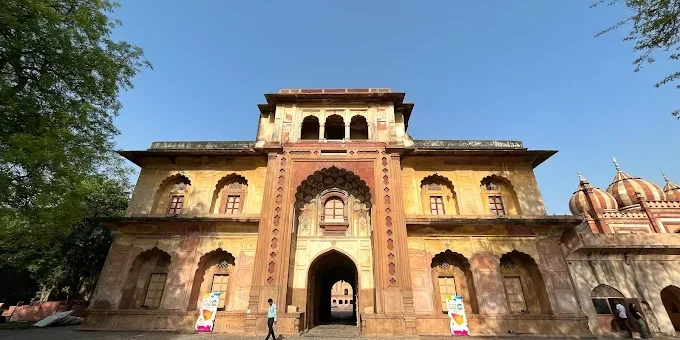
Long ago, past 1754, they raised Safdarjung's Tomb in South Delhi - now one of its lasting landmarks. Built for Safdarjung, who led as chief minister when Muhammad Shah ruled the Mughals, his power shaped royal decisions deeply. At the center of wide charbagh lawns, it rests where paths meet at sharp angles, lined by silent fountains and runnels guiding clear water. Sunlight hits first on red sandstone, then glints across marble panels layered into walls like quiet contrast. Up above, a main dome lifts into the air, encircled by four slim towers standing eight-sided, their surfaces etched with swirling patterns and capped with tiny domes. Reaching inside happens through broad archways, once sharp in detail though now softened by years passing. Later than the finest Mughal buildings, yet its shape whispers of past royal forms, hinting how old thoughts kept breathing. Silence rests close at Safdarjung’s tomb, even when it shines with less majesty than Humayun's. Silence fits between the walls, where every arch leans into memory like a familiar voice. Stone remembers what people forget, holding moments without needing to explain. Away from rushing lanes, stillness settles - uncommon, yet present in this part of North India. Tourists stop, lenses catch light, curiosity rises unspoken. Those who chase echoes of older Delhi somehow end up walking quieter on these paths.After her husband passed away, Shah Jahan Begum took charge of building the Safdarjung Tomb in 1754. Even though the Mughal Empire was losing power by then, influence still gathered around one man - Safdarjung, whose full name was Mirza Muqim Abul Mansur Khan - and he held great political reach. This tomb reflects that time, revealing how rank shaped life among high-ranking Mughal figures. Designed much like older royal garden tombs, it shows signs of a shrinking era: smaller size, simpler details when set beside Humayun’s far more elaborate mausoleum. Its shape speaks not of triumph but of slow retreat, hinting at waning force instead of enduring might. Still standing after centuries, Safdarjung's Tomb bears light scars from rough times. Gardens shaped like charbaghs sketch heaven in Islamic vision - paths aligned, water threading through. Though damaged here and there, it survived. Tended by the Archaeological Survey of India, year on year, it held together. More than stone and mortar, the tomb holds a pause - elegance softened by simplicity. Today, tucked into calm south Delhi, it whispers of how empires were built, lived, and dreamed.Nearby Places to Visit Safdarjung TombLodhi Gardens: Lodhi Gardens lies a quick walk to the northeast, home to old tombs tucked into leafy corners. Sunlight pulls people along winding trails rather than packed lanes. Under trees older than memory, food baskets settle beside quiet visitors.Humayun's Tomb: A stone's throw from Safdarjung’s grave, Humayun’s Tomb rests, only about six kilometres distant. Though nearby, this UNESCO-recognised monument rises larger, more intricate than its predecessor. Design-wise, it moves ahead, revealing shifts in Mughal garden-tomb thinking across years.Qutub Minar: Over there, about twelve kilometres away, stands Qutub Minar - simple, yet impossible to miss. Curious minds often arrive unannounced, pulled by something they can’t name. Those who study shapes made of brick and beam come just to listen. Named by UNESCO, it rests among treasures marked for keeping. Nothing else climbs quite like it does, slow and ancient, into the open air.India Gate: Almost ten kilometres away, the moment darkness begins to settle, people start making their way toward India Gate. Around its base, open grassy stretches spread out, interrupted by arcs of water leaping into the air, shimmering under the last orange streaks of sun.Lotus Temple: Drifting above the city's rim, eight kilometres out, sits a temple shaped like an open blossom. Light slips between curved marble leaves, pulling some visitors to stand still. A worship space for the Bahá’í tradition, it holds quiet like water in stone. Words fade there - sound thins, footsteps soften.Best Time to Visit Qutub MinarSummer (April to June): Summer heat grips Delhi between April and June, with readings regularly breaking 40°C. Dawn light softens the edges of the mausoleum, just as evening shadows start stretching across the lawns. Midday sun presses down, turning open areas into zones of discomfort. The morning cool doesn’t last long, yet it gives a pause before the furnace kicks in. As daylight thins, there’s a stretch where the air loses some sting.Monsoon (July to September): Come July, showers start popping up, easing the scorch a bit. Green bursts on trees near Safdarjung Tomb once damp air soaks into bark. Yet heavy drops might slam down out of nowhere - tripping anyone eyeing a quiet walk. While drizzle rules more than deluge, some outings still sink when streets gulp water fast.Winter (October to March): Winter stretches from October to March, bringing gentle temperatures - usually above 10°C, below 20°C. Thanks to that balance, wandering among tombs or strolling garden paths works well. Trails remain passable, while skies tend toward calm, easing travel across spots.How to Reach Qutub MinarBy Airport: You’re looking at Indira Gandhi International, code name DEL - about 12 kilometres off. Taxis wait outside, ride apps work too, or hop on the metro should tracks suit you better. Moving through settles easily when paths like these line up.By Railway Station: Hazrat Nizamuddin stands just 6 kilometers out. Getting there works easily from nearly any city nearby. New Delhi Railway Station shows up a bit further - roughly 10 kilometers off. Even so, trains arrive and leave on steady schedules.By Road: A ride along Delhi's linked-up streets leads directly to Safdarjung Tomb. Nearby, choices pile up - buses roll in, rickshaws idle, cabs hover - each one set to drop you at the gate. The nearest metro point sits underground: Jor Bagh, found on the Yellow Line. Step out, then let your feet take over. Distance spans about a thousand metres; walking it feels light, almost effortless.