

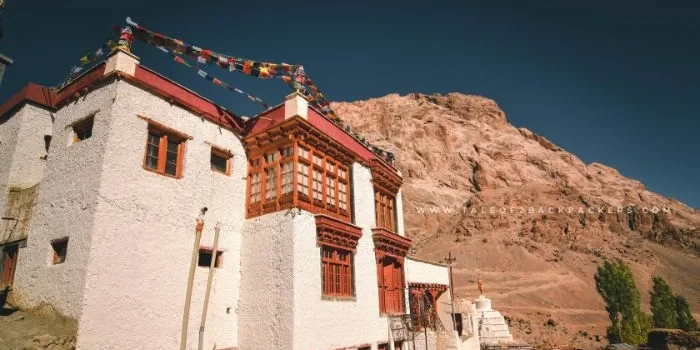
West of Leh, around seventy kilometers away, sits Mangyu Monastery - quiet, tucked into a remote village few travel to. Hidden among steep gorges and untouched landscapes, it feels more like a whisper than a landmark. Part of the Alchi cluster of sacred sites, this gompa often plays second fiddle but carries equal weight in history. Its buildings speak through aged wood and faded murals instead of loud claims. Though smaller than others, its roots run deep into ancient belief systems and forgotten art forms. Back in the eleventh century, when translation work shaped faith across these mountains, a man named Rinchen Zangpo led the change. He stood central to bringing Buddhist teachings alive in Ladakh soil. Under his guidance, temples rose - not just as structures, but as living records of devotion. Perched high, the pair of temples at Mangyu hold deep meaning for followers of the Buddha. Covered inside with paintings, carved woodwork, and delicate clay figures, their art stuns without trying too hard. Tibetan touches blend with Kashmiri forms here - craftsmen once stitched together separate worlds through skill. Peace lingers in the air around the monastery, pulling people into stillness. Rugged terrain wraps it tight, along with common village houses, yet calm lives within these walls anyway. Walking away from crowded temples, some travelers find their way to Mangyu for silence among trees. Not drawn by crowds, they move slowly through still air, pulled instead by old stones and painted walls. For others, history hums louder than noise ever could - faded murals speak without sound. Art lives here, not in galleries but on cracked clay surfaces shaped centuries ago. Meditation feels different when surrounded by chants that linger in stone. The past does not shout; it waits quietly inside each carved doorway.Mangyu Monastery ties closely to how Buddhism spread again in Ladakh between the 10th and 11th centuries. Stories passed down by monks show teachings from both Hinayana and the balanced path of Mahayana took root then. This revival often links to Lotsava Rinchen Zangpo (958–1055 AD), a key Buddhist translator and thinker. He played a major role bringing Buddhist practice back across the high mountains. During the rule of Western Tibetan royalty, he likely oversaw construction of multiple religious sites - Mangyu being one. It belongs to what experts call the Alchi cluster, alongside Alchi itself, Sumda Chun, and smaller nearby shrines. What makes these monuments stand out is how their designs mix Indian and Tibetan art in a way found nowhere else, born from connections among Kashmir, Tibet, and Ladakh over time. Though unnamed, the sculptors and painters behind the murals likely came from Kashmir, hinted at by fine patterns and familiar techniques seen across regions. Standing together inside the monastery are two places of worship - Vairocana Temple and Avalokiteshvara Temple - not separate but linked in purpose and form. Inside them rest clay figures of deities, frescoes showing enlightened beings on walls, wooden engravings filled with precision - all shaped so carefully they’ve held up close to a thousand years. Travelers interested in Buddhist heritage often explore Mangyu Monastery through our Leh Ladakh Tour Package.Nearby Places around Mangyu MonasteryAlchi Monastery: High up near Mangyu, Alchi Monastery stands quiet, holding centuries of stillness within its walls. Built during the 1000s, it carries echoes of old faith through layered paintings on stone and timber. Wooden beams twist into delicate patterns overhead - each one shaped by steady hands long gone. Paintings stretch across rooms in soft tones, showing stories without noise or hurry. This place speaks through colors more than words, rooted deeply in Kashmiri craft blended with Indian form. Though separate in location, it ties tightly to nearby sacred spots, forming a shared legacy.Likir Monastery: High above the valley, Likir Monastery sits about 25 kilometers from Mangyu. From miles away, eyes catch the towering 75-foot figure of Maitreya Buddha standing bold against the sky. This working monastery follows the Gelugpa tradition, humming with chants during daily prayers. Festivals bring color and rhythm to its stone walls when monks gather in ritual. Distance does not dull its presence; the statue watches like a quiet guardian across the land.Basgo Monastery: Down the road roughly thirty five kilometers sits Basgo Monastery, where old meets now without effort. Ancient paintings line its walls while broken fort remains stand nearby, topped by a towering figure of Maitreya Buddha. Once used for prayer, it also served as defense during Ladakh's warrior centuries - history hums through stone and silence here.Leh Town: Down a long road from Mangyu, about seventy kilometers leads into Leh. This place runs Ladakh’s culture and government both. You will find old buildings like Leh Palace, calm spots such as Shanti Stupa, along with busy market lanes full of color.Best Time to Visit Mangyu MonasterySummer (May to September): Mangyu Monastery sees its busiest days between May and September. The weather settles into a quiet rhythm, usually staying between 15 and 25 degrees - just right for walking around. Paths that stay blocked earlier in the year finally clear up, opening access without trouble. Alchi appears reachable on wheels, not far off by road during these months. Likir also becomes an easier stop, linked well when routes dry out under the summer sun.Monsoon (July to September): Summer rains arrive elsewhere, yet Ladakh stays mostly dry - sheltered by high mountains that block storm clouds. Around Mangyu, the land turns lush, painted fresh with green after rare showers. You may see mist roll through the valley, softening sharp cliffs into gentle shapes. Travel moves smoothly overall, though some paths could turn slippery when skies open above the peaks.Winter (October to April): When winter arrives, from October through April, the air turns sharp and cold, sometimes hitting minus ten degrees. Roads leading to Mangyu might vanish under thick layers of snow, cut off entirely. Yet those drawn to deep frost will find quiet beauty in the monastery’s stillness. Villages nearby wear silence like a coat, hushed beneath frozen skies. A sense of calm settles differently here, shaped by ice and solitude.How to Reach Mangyu MonasteryBy Airport: From the air, reach Kushok Bakula Rimpochee Airport in Leh - about 70 kilometers out. Daily planes land there from Delhi, Srinagar, plus some other Indian cities. Once in Leh, a taxi or shared ride can carry you toward Mangyu without much trouble.By Road: Travelers by road often find Mangyu without trouble along the Leh–Srinagar highway. From Leh, head toward Alchi before shifting direction at that point for the village of Mangyu. Most trips last between two and three hours. Along the drive, views open up across the Indus Valley - a spot many describe as striking. That landscape unfolds gradually through the windows.By Railway Station: Starting at the railway - Mangyu has no train access nearby. The closest major stop sits near Jammu Tawi, roughly 700 kilometers out of reach. From that point onward, a flight links Jammu to Leh. After landing, road travel takes you toward Mangyu by vehicle.