

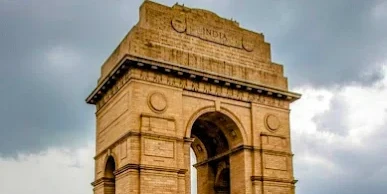
At the heart of New Delhi stands the India Gate, often seen as the city's focal landmark. This monument ranks among India’s most notable national symbols. Designed by Sir Edwin Lutyens, the grand arch draws frequent comparisons to Paris’s Arc de Triomphe. Rising 42 meters into the air, it holds its presence quietly. Not every tall structure tells a story, but this one does. Green spaces bloom around the tall stone arch, water sprays up in rhythmic bursts, flower beds circle outward - this setting lifts the presence of India Gate. Visitors fill the area, locals mix with travelers, many pausing just to sit and breathe slow. Names carved deep into the structure belong to those who never came back from battles long ago - one war followed by another. A quiet flame appeared beneath the archway decades later, marking sacrifice beyond earlier conflicts. When dark falls, brightness takes over; lights climb the walls, colors shift through mist rising from lit pools nearby. Gatherings happen here now - not just memory held still, but music sometimes, voices raised together, families strolling past dusk. It stands open always, among the busiest parts of the city yet somehow apart.Out near the center of New Delhi, the monument stands exactly where Lutyens wanted it. A royal hand placed the first stone back in 1921 - that honor fell to the Duke of Connaught. Ten years passed before work finished. The structure emerged from a vision by British designer Sir Edwin Lutyens, shaped to remember troops lost in World War I and the Third Anglo-Afghan conflict. It began life called the "All India War Memorial," holding close the memory of over thirteen thousand named fighters. Their identities run across its walls, etched deep. Though time changed some meanings, placement stayed fixed - central, firm, part of how the city took form. Once free from British rule, India placed the Flame of the Immortal Soldier beneath the arch - a tribute sparked by loss in the 1971 conflict with Pakistan. Though decades have passed, that flame continues burning, standing as quiet respect for those who gave their lives. What began as a monument shaped under empire now stands taller in meaning, reflecting national strength through remembrance. Instead of just honoring old wars, it pulses with current identity, marked each year when the Republic Day procession moves past its base. With every step taken nearby during celebrations, history folds into today, making the structure more than stone - memory made visible.Nearby Places to Visit: India GateRashtrapati Bhavan: A grand residence sits on the far west stretch of Rajpath - home to India’s President. This isn’t just known for size or elegance. Instead, many notice the Mughal-style gardens tucked within its grounds. Beauty here grows from layout, yes - but more so from tradition rooted in design. Few spots blend function and form quite like this do.National War Memorial: Standing close to India Gate, this modern tribute rises with clean curves and strong form. Its round shape holds never-dying fires, glowing in honor of fallen troops from post-independence conflicts. Stone figures speak without words, shaped to remember sacrifice. Flame circles burn on, marking courage through years gone by. This place stands quiet, yet loud in meaning, honoring those who served beyond the call.Rajpath: A grand road cuts through New Delhi, linking India Gate to the President's residence. This path hosts the annual parade every January, drawing crowds by tradition. Strolls happen here after sunset too, when lights come on slowly. Official events often unfold along its wide stretch, watched by many.National Museum: Almost three kilometers distant, the National Museum gathers echoes of time - where old whispers meet today’s breath, then stretch into what might come. Artifacts rest here like quiet witnesses, threading Indian legacy through global stories across ages. Not just containers of history, they become bridges where moments touch, centuries overlap, meaning shifts without announcement. This place does not stand still; it hums with layered voices speaking in textures, colors, shapes. What was once local now travels beyond borders, carried by curiosity older than memory.Connaught Place: A short walk takes you to Connaught Place - just 2 kilometers away. This part of Delhi hums with business activity while holding deep cultural roots. Shops draw people in, restaurants keep them lingering. Old buildings stand tall, built during colonial times, adding character. Its mix of life makes it a go-to spot for many.Best Time to Visit India GateSummer (April to June): When summer hits - April through June - India Gate bakes under scorching sun, temps often jumping past 40°C. Not many stick around by noon; it's simply too harsh. Yet once dusk settles, a slow calm returns. Evenings open up space for walks, cooled by occasional breezes. Heat fades, so do crowds thin out just enough. Some find relief only after daylight weakens. By nightfall, the monument glows softer, easier to take in.Monsoon (July to September): When July hits, rain arrives, washing Delhi in cooler air. Gardens near India Gate respond fast - lushness spreads across lawns and hedges. Showers often come without warning, brief but heavy, catching visitors off guard. These bursts of weather do not last long, yet they add a quiet sparkle to pathways and trees. Even if plans pause under falling drops, the mood shifts into something softer, more alive.Winter (October to March): Cold months stretch from October through March. That period feels just right for visiting, when thermometers sit between 10 and 20 degrees. A parade rolls out each January on Republic Day - bright, loud, part of why people come. The event gives the place extra meaning.How to Reach India GateBy Airport: From the airport, it's about 15 kilometers to India Gate - Indira Gandhi International Airport (DEL) sits closest. Taxis get you there, though cabs work just as well. The metro rolls in frequently, offering another path. Drivers behind the wheel of private cars show up too, ready to go.By Railway: New Delhi Railway Station sits just 5 kilometers away. That one links easily with nearly every part of India. A bit farther out, Hazrat Nizamuddin is at 7 km. Trains roll through there nonstop too.By Road: Delhi’s connected well through highways and city lanes. Public buses show up regularly, while auto rickshaws wait at corners, ready to move. Taxis cruise nearby areas, plus digital ride apps work just fine when booked on phones. Another way - using the metro - saves time and stress. That stop sits near Central Secretariat, where Yellow and Violet lines meet. From there, walking two kilometers brings you straight to the monument.