

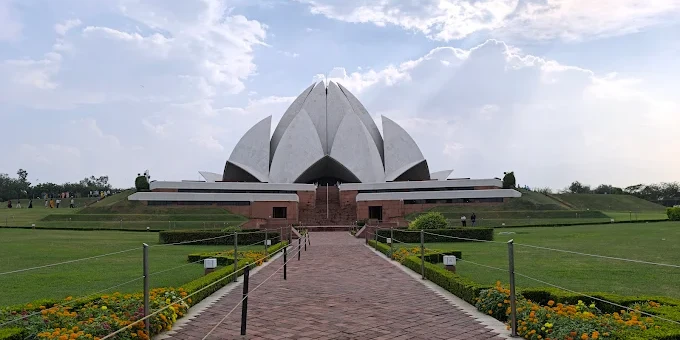
Every now and then, a building comes along that stops you mid-step - the Lotus Temple in South Delhi does exactly that. Shaped like a blooming flower, it stands as one of India's most striking structures. Beauty here isn’t just seen; it feels quiet, balanced, peaceful. Open to everyone, regardless of faith, it serves as a Bahá’í place of worship without barriers. Completed back in 1986, its form unfolds through 27 marble-covered petals. Grouped in sets of three, these pieces build up into a shape with nine edges, clean and precise. Outside, nine pools wrap around the structure, bringing a quiet feeling to the space. Thousands fit inside, thanks to wide open halls and roomy design. People come here looking for stillness, sitting quietly amid soft echoes. Instead of statues or pictures, silence fills the air - prayer happens through still minds, not spoken words. Sunlight slips in gently, touching walls shaped simply, blending with reflections from water nearby. That balance pulls in those drawn to faith, form, or just moments without noise.Out of a vision by India’s Bahá’í community rose the idea for the Lotus Temple. Fariborz Sahba shaped that thought into stone and form, crafting a silhouette echoing a blooming lotus. Work started under open skies in 1980, finished six years later beneath those same skies. Its presence rewrote what modern architecture could mean in Delhi. Nature guided the shape - specifically the sacred lotus, tied deeply to ideas of purity, affection, and endless life here. Rooted in ideals like harmony, oneness, and fairness, the space opens wide to every person, no exceptions. Since first touched by shovel and soil, it has drawn global notice, honored again and again for how its marble-clad petals stand tall through clever engineering. Slowly, it turned into more than just a place for prayer - now standing as one of Delhi’s most recognized cultural symbols, shaped by design and meaning: balance, openness, beauty. Peaceful pathways wind past still waters and green lawns, matching the calm found inside the temple walls, making it a spot of silence within the rush of urban life.Nearby Places to Visit Lotus TempleQutub Minar – Just under 12 kilometers away from the Lotus Temple stands Qutub Minar, built from red sandstone. Recognized by UNESCO as a World Heritage Site, it shows how Islamic and Indian styles came together in design. Towering above the landscape, its intricate carvings tell stories without words. This minaret remains one of the earliest mosques constructed on the Indian subcontinent.Humayun’s Tomb – A stone's throw from the Lotus Temple, about six kilometers out, sits Humayun’s Tomb. This grand resting place rises within a lush quadrilateral garden, shaped by old Mughal design. Laid out like a classic charbagh, the greenery frames the structure in quiet symmetry. Recognition came through time - now it holds a spot among UNESCO’s protected wonders. Distance blurs but landmarks stay fixed; one leads naturally to the next.ISKCON Temple – Down the road from the Lotus Temple, about ten kilometers away, sits a vibrant place of worship focused on Lord Krishna. This building stands out not just for its design but also for the lively events held inside. Energy fills the air during gatherings here, where devotion takes center stage. Architecture plays a role too - bold shapes and colors catch the eye without trying too hard. People come often, drawn by rhythm, sound, and color woven into daily life.Nehru Planetarium – A dome rises beside the temple in Chanakyapuri, quietly standing apart. Inside, moving images paint stories of stars, planets, and how space works. While some visit for quiet reflection, others find wonder in glowing constellations above. Each show unfolds slowly, revealing secrets without rushing. Light shifts across curved walls like night meeting dawn. Visitors leave with quieter minds, filled with slow thoughts.Garden of Five Senses – A short walk from the temple - just under four kilometers - lies a place shaped by touch, sound, scent, sight, yet built by hands. Trees bend around sculptures you can hear when wind moves through them. Visitors come during festivals where flavours appear in shared meals beneath open skies. Art stays fixed, though seasons shift all around it. This space does not rush, instead, lets moments stretch into memory.Best Time to Visit Lotus TempleSummer (April to June): When April rolls in, Delhi heats up fast - by May, thermometers regularly climb past 40°C. Try mornings or evenings if stepping outside; midday air feels like an open oven. Late twilight walks work better once the sun dips low.Monsoon (July to September): When July rolls in, skies open up. Rain cools everything down after long stretches of heat. Lush greenery wakes up around the temple grounds. Paths turn soft underfoot, leaves drip constantly. Sightseeing can slow to a halt if storms linger too long. Water pours harder on some days, making walks messy. Still, the land drinks deeply, looking richer each week.Winter (October to March): Cold months arrive. Between October and March, temperatures stay mild, hovering near 10 to 20 degrees. That comfort means temples feel inviting. Parks nearby? Just as good. Fewer sweaters are needed. Still, mornings might bite. Sunlight lingers longer here than expected. Footsteps on stone paths sound clearer in crisp air. Leaves hold still more often now. Visitors wander without a rush. Quiet settles more easily when skies turn pale.How to Reach Lotus TempleBy Airport: Indira Gandhi International Airport (DEL) sits roughly 20 kilometers nearby. Taxis roll in regularly, cabs wait on call, while the metro slips through stations just steps away. Reaching your spot feels smooth when wheels keep turning.By Railway: From the railway, Main Nizamuddin at six kilometers stands near; travel options open easily from there. Twelve kilometers away, New Delhi station also links well into the network.By Road: Finding the Lotus Temple by car works fine since Delhi's roads connect well across neighborhoods. Public transport offers options like buses or three-wheelers if you prefer not to drive. Ride-hailing vehicles through apps also reach right up to the entrance. Near the site, the Kalkaji Mandir stop on the Violet subway line stands closest. A short walk follows once you exit that station.