


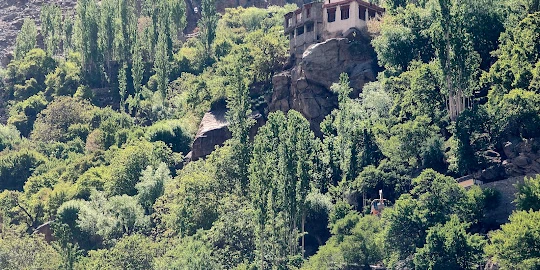
Twin villages named Dah and Hanu sit high in Ladakh’s Indus Valley near the edge of Indian-administered Jammu & Kashmir. Perched around 3,200 meters up they draw attention not just for customs kept alive over centuries but because roots tie deep into Dardic pasts. Old homes built from sun-dried bricks stand along narrow lanes shaped by time rather than plans. Fortress-style structures rise quietly among clusters of dwellings where life follows rhythms older than memory. Farms tucked between rocky slopes grow apricots while barley spreads across small plots carved into steep land. Herders move yaks and goats seasonally using trails passed down through generations. Food grown here feeds families first though some finds its way beyond mountain passes. Culture lives loud in chants at festivals dances on rooftops and tools hung inside weather-worn walls. These places hold stillness like an inherited habit yet change creeps in slow motion. What remains clear is how much depends on balance - between soil sky effort and time. Folks passing through tend to get caught up in lively festivals, traditional dancing, little moments of warmth from villagers. Deeply rooted spiritual habits here blend Buddhist ways with old Dardic roots - shrines tucked into corners, cloth prayers fluttering on lines, rhythmic steps marking seasonal turns. Even amid tough routines shaped by strict norms, life pushes forward in the rough stretches of Dah and Hanu. Beauty grabs attention first, yes - but staying power lies in how culture holds firm, how balance grows between people and towering mountain rhythms across Ladakh’s quiet backdrops.Old traces of Dah and Hanu stretch back through many ages, tied closely to the Dardic people. From Central Asia they came, the Dards - part of the Indo-Aryan family - settling into the Indus basin long ago. Clear streams ran down from peaks, soil stayed rich; because of this, life took root firmly in these villages across the lush flatlands near the river. Their spot on ancient trade paths between Ladakh, Baltistan, and highland routes gave them quiet strength - one village watching over movement like a silent guard. With time, location turned them into unseen hinges where armies passed and cultures brushed close. Trucks moved goods back then just like caravans once did, bringing wool, salt, grain through village paths long ago. Still standing today are homes built like forts, towers meant to block both invaders and biting winds when snow came hard. Far from common Ladakhi ways, the people of Dah and Hanu held tight to customs all their own. Old tales they tell sound distant, shaped by belief systems older than most remember, touched later by Buddhism too. Shina, spoken among them, traces roots deeper than many tongues around these mountains. Peaceful overlap grew slow - temples rose beside sacred spots, blending form without force. Stone shapes took new meaning, neither fully one nor another, but something quietly joined over time. Culture enthusiasts often explore Dah and Hanu Villages through our Leh Ladakh Tour Package to learn about the Brokpa community.Nearby Places around Dah & Hanu VillagesLeh Town: Around ninety kilometers stretch between Dah and Hanu, with Leh sitting central in both culture and governance for Ladakh. Instead of just visiting the Palace or Stupa, travelers often wander through market lanes hunting handmade crafts and old-style keepsakes. From here - starting point for many - it's common to set off toward those distant villages. The town acts like a hub, quietly supporting journeys that lead elsewhere.Basgo Monastery: Around sixty kilometers from Dah and Hanu sits Basgo Monastery, standing quiet yet full of stories. Old murals line its walls, painted long ago, while strong stone structures rise like sentinels. During medieval times, this place held great power across Ladakh. Though quieter now, visitors still walk through to see how faith shaped the land. Its halls speak of an age when religion built empires.Magnetic Hill: Down a stretch near Dah and Hanu, about 100 kilometers out, lies Magnetic Hill. Cars left in neutral appear to roll upward, defying what we expect from gravity. This oddity pulls travelers now and then, especially those tracing the Indus Valley route. Scenic views come along with the mystery, making it a quiet favorite among passersby.Diskit & Hunder (Nubra Valley): Far from the rush, Diskit and Hunder sit tucked in Nubra Valley, roughly 150 kilometers apart. The monastery in Diskit draws eyes upward with quiet presence. Over near Hunder, golden sand stretches under open sky. Travelers often pause at the towering Maitreya Buddha figure, still amid the wind. Instead of walking, some choose a slow camel ride on Bactrian camels across the dunes. High above sea level, the land feels empty yet full. This stretch of desert stuns without trying. Few places match its silent scale.Best Time to Visit Dah & Hanu VillagesSummer (May to September): Sunlight stretches long across the valleys when May arrives, lighting up paths toward Dah and Hanu. Warmth sits between 15 and 25 degrees most days, just right for moving through villages on foot. Treks feel lighter under clear skies, while chatter from locals blends into the breeze. Green spills over terraced fields, alive with growth. Apricot trees wear clusters of blossoms, delicate against sharp mountain air.Monsoon (July to September): When rains arrive between July and September, Ladakh sees brief wet spells despite usually getting little rain. Though not common, these downpours bring out patches of green where dust often rules. Waterways swell suddenly, cutting through valleys with sharper flow. Travel remains possible during this time, though paths may pause when slides block routes. A stretch of flooded ground here or there can shift plans quietly.Winter (October to April): When October arrives, winter sets in hard. Cold pushes past minus fifteen some days. Roads vanish under thick layers of snow. Still, quiet settles over the villages blanketed white. Beauty hides where frost lingers longest.How to Reach Dah & Hanu VillagesBy Airport: From the air, reach Leh’s Kushok Bakula Rimpochee Airport - sits roughly 90 kilometers out. Flights link Leh with major hubs such as Delhi, Srinagar, even Chandigarh. A taxi ride could take you onward, or join a group trip leaving Leh bound for Dah & Hanu.By Road: Travel by road leads to Dah and Hanu villages using NH1 from Leh. Roughly two to three hours long, the route moves past wild landscapes, ancient homes, and modern ones too along the Indus Valley. Shared taxis work well. So do personal cabs or a motorcycle if that suits better. Scenery shifts often - rocky stretches give way to green fields without warning.By Railway Station: Near the train stop: Right now, no rail route runs straight into Dah or Hanu. Most nearby is Jammu Tawi, sitting some 700 kilometers off. Visitors might take a plane from Jammu up to Leh, afterward riding overland toward the settlements.