


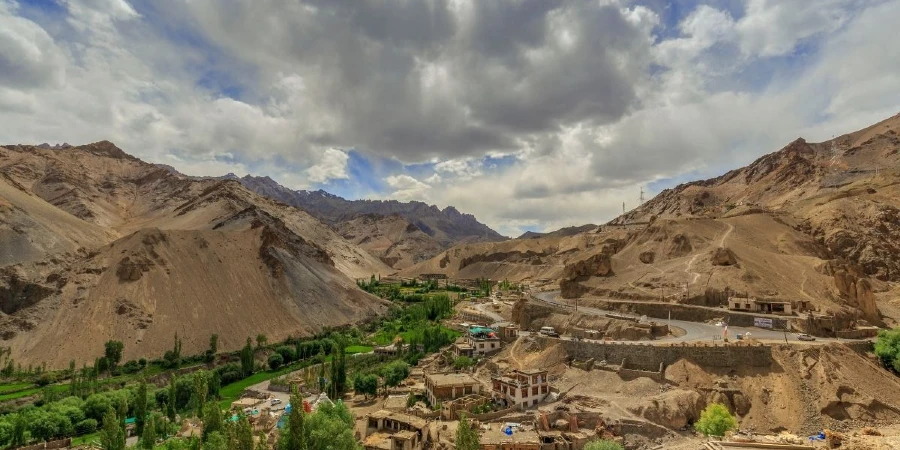
Not far from Leh, along the road connecting to Srinagar, sits Uleytokpo - a quiet spot beside the Indus River. Roughly seventy kilometers out, this small settlement often slips past travelers heading toward Lamayuru or Kargil. Though many pause only briefly, the area holds a stillness few others match. Where much of Ladakh shows rocky, empty hills, here patches of green stretch between orchards. Apricot trees rise near farm plots, breaking the usual harsh tones of stone and dust. Instead of endless dry slopes, there’s life - fields tucked close to homes, framed by towering but bare peaks. Beauty appears quietly, without announcement, in how color meets desert. The landscape speaks softly, through contrasts rather than grand displays. Right around 10,000 feet up, Uleytokpo sits quiet, offering stays that blend into nature without fuss - simple homes where calm comes easily. Flowing slow, the Indus wraps nearby land while nights stay wide open above, perfect for sitting still, looking up, or just breathing deep. Culture lives close here, where visitors meet Ladakhi ways through shared meals, talk, and daily rhythms. From this point on, trips unfold toward Alchi or Likir - monastery visits wait, along with trails through Sham valley stretch out ahead. For anyone drawn to both safety and truth, Uleytokpo balances earth and tradition in a way that feels right.Under the shadow of old mountains, life in Uleytokpo took shape alongside Ladakh's deep-rooted traditions and quiet beliefs. Once nestled within Sham - known by some as the Apricot Valley - it drew early settlers thanks to gentle elevations and fertile stretches beside the Indus. Because traders once threaded their way through this valley, linking distant lands like Tibet, Kashmir, and parts beyond Central Asia, customs flowed here like water. Goods changed hands, thoughts crossed paths, and slowly a blend formed - not forced, just lived. By medieval times, faith found strong ground; nearby settlements, including this one, became centres where Buddhist teachings were studied, shared, and shaped. Tucked into the landscape, Alchi Monastery rose in the 1000s thanks to Rinchen Zangpo, a scholar who shaped spiritual paths across the land. Ancient paintings inside its halls, carved wooden beams, sacred texts - these survived because artisans from Kashmir blended their skills with those from Tibet. Locals from Uleytokpo kept watch; they fed fires during winter rituals while preserving chants passed down through the years. Likir and Rizong stood further along the valley, yet shared the weight of memory, each holding parts of belief systems that wove through daily life. Power shifted slowly here; kingdoms shrank when borders redrew themselves under colonial steps. Before modern maps arrived, Ladakh ruled itself, long before outsiders marked highways through mountain passes. Traders moved goods between Srinagar and Leh, but armies followed close behind, leaving traces in soil and stories alike. Travelers seeking peaceful landscapes and Himalayan scenery frequently choose our Leh Ladakh Tour Package, which includes visits near Uleytokpo.Nearby Places around UleytokpoAlchi Monastery: Just past Uleytokpo, around ten kilometers away, sits Alchi Monastery - a cluster of dwellings thought to be close to eleven thousand years in age, tucked into India's Ladakh zone. Marked by unique Indo-Tibetan artwork, ancient wall paintings appear alongside carved wooden details, shaped through cultural mixing across the area, likely guided by artisans from Kashmir.Likir Monastery: Likir Monastery sits high on a slope, twenty-two kilometres out from the valley floor. Perched above the land, it watches over snowy peaks and distant trails visible from its ledges. Teachings of the future Buddha echo through its halls, passed down like breath in cold air. Old scrolls rest inside, fragile pages holding words long shaped by silence. Artifacts lie displayed, each one worn smooth by time's thumb. From up there, sightlines stretch beyond villages, reaching corners few ever walk. Heights give more than views - they lend presence.Rizong Monastery: Rising above the valley floor, Rizong Monastery sits within towering cliffs, a quiet spot shaped by silence and routine. Located roughly 15 kilometres from Uleytokpo, it feels tucked away, almost hidden. Life there moves with precision, guided by long-held rules and steady practice. Known widely as the "Paradise of Meditation," it draws few but leaves deep impressions.Lamayuru Monastery: Lamayuru Monastery sits roughly 35 kilometres from the valley, standing as both the biggest and most ancient in Ladakh. Though time has shaped its walls, it's the lunar-like terrain that catches eyes first. Instead of grand claims, the place speaks through quiet ridges and stone shadows. Each year, the Yuru Kabgyat festival fills the air with rhythm and color, drawing those who listen closely to the past.Best Time to Visit UleytokpoSummer (May to September): Warm days fill the air from May through September. During these months, Uleytokpo welcomes visitors with ease, as thermometers hover between 10°C and 25°C. Green spills across the valleys like paint spilled wide open. Rivers move slow, almost humming under clear skies. Exploring trails feels natural when the sun shines soft overhead. Staying in small eco-lodges becomes part of the rhythm, blending into daily life here.Monsoon (July to September): Heavy rains fall across much of India from July to September, yet Ladakh stays mostly dry because mountains block the clouds. Instead of downpours, light rain passes through now and then. Water fills the Indus River, swelling its flow beyond the usual trickle. Lush green edges appear along riverbanks, changing how the villages look. Most popular spots remain open to visitors throughout these months. Though paths may get muddy after rare storms, vehicles still pass without serious delays. Scenery grows richer under moister skies, offering views different from drier seasons.Winter (October to April): When October arrives, Uleytokpo's winter digs in fast - temperatures sink far beneath zero, staying there for months on end. Snow piles high, cutting off the village completely as guesthouses and shops shut down one after another. Still, those drawn to silence and untouched landscapes might find something real here, if they can handle frozen mornings and long nights. Few come, yet some leave changed.How to Reach UleytokpoBy Airport: Starting at the nearest airstrip - Leh's Kushok Bakula Rimpochee - it sits roughly 70 kilometers out. Flights arrive here straight from hubs like Delhi, Mumbai, and Srinagar, among others. Once on ground in Leh, travelers head toward Uleytokpo using either taxis or public buses. That stretch takes close to two hours by road.By Road: Along the highway, Uleytokpo sits right on the road linking Leh and Srinagar - this stretch known as NH1. From either city, transport options like cabs, coaches, or self-hired vehicles pass through often. Scenery fills the journey, since views of the Indus River come easily, framed by surrounding peaks. Though long, the ride holds steady charm mile after mile.By Railway Station: Trains don’t reach Ladakh. Nearest stop is Jammu Tawi - about 700 kilometers off. Flying into Leh from Jammu works. Another path opens through Srinagar, then onward by road toward Uleytokpo.