

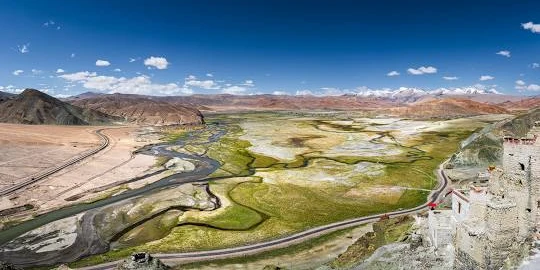
Far from crowds, tucked into Changthang’s quiet heart, sits Hanle - a small settlement few ever reach. Not near much of anything, it rests just shy of the Indo-China line, boxed in by barren peaks, open flats, and air so clear it feels thin enough to break. At around 14,700 feet, the sky does not blur here; it sharpens, turns crisp, almost loud in its clarity. What makes Hanle stand apart? A telescope hub perched above the clouds - the Indian Astronomical Observatory - rare for how high up it stands. Because of that dome watching the stars, researchers show up, along with night-sky photographers chasing silence and light. What stands out most is how clean air and few people help make the night sky here incredibly clear - stars of every size show up easily, along with bright ones across the Milky Way. Still, beyond research work, Hanle holds deep cultural roots. Sitting high is the 17th-century Hanle Monastery, tied to the Drukpa Kagyu tradition of Tibetan Buddhism. This sacred site belongs to Ladakh’s living spiritual history. Even older, the land supports the Changpa nomads, whose lives include herding pashmina goats and crafting fine wool right through Hanle. Not just known for telescopes or temples, the place stuns anyone passing by with raw landscapes and quiet beauty. Some say what makes it special isn’t just the sweeping meadows but also glimpses of creatures like the Kiang, along with the quiet flow of the Hanle River nearby. For anyone drawn to raw untouched landscapes where stillness fills the air and night skies brim with endless constellations, Hanle emerges - not loud, not flashy - as a rare gem tucked within Ladakh’s vast stretch.Spiritual roots run deep in Hanle, shaped by movement across open lands. For ages, this place belonged to the vast Changthang Plateau - stretching into high basins, bordering Tibetan zones, tucked within western uplands. People here moved with seasons, herding yaks and soft-haired goats, surviving off rhythm, not routine. Life unfolded slowly, tied to animals, sky, and shifting pastures. Centuries passed without fixed walls, only tents and trails worn by time. Their way stayed untouched, carried forward through silence, dust, and cold winds. Doing this kept them aligned with nature, while tying their lives closely to one of Earth’s toughest landscapes. What stands out most in Hanle’s history is the monastery passed through generations - Hanle Gompa - now centuries old. Built sometime between 1616 and 1621 under Ladakhi ruler Sengge Namgyal, it belongs to the Drukpa Kagyu branch of Tibetan Buddhist practice. For folks across Changthang and nearby zones, the site carried deep spiritual weight, linking different threads of belief into one space. Back when monk numbers peaked, with learning and quiet reflection at full swing, several hundred lived within its walls. Today, Hanle breathes life into Buddhist tradition - not just in faded wall paintings, worn sacred objects, or rooms filled with chants, but in daily rhythms that persist. Its significance stems not only from spiritual roots, yet equally from location - nestled near high plateaus, close to contested lines between nations. Long before modern maps were drawn, threads of culture passed through here, carried along ancient paths linking distant valleys of Tibet and Ladakh. Travelers passionate about astronomy and remote Himalayan landscapes often choose our Leh Ladakh Tour Package featuring Hanle.Nearby Places around HanleHanle Monastery: Up on a ridge above the village sits Hanle Monastery, built long ago in the 1600s. This old stone place once led the Drukpa Kagyu teachings. When you stand near it, eyes meet wide-open sky stretching across valleys below. What strikes most is how still everything feels, like time slowed down centuries back. Views stretch far, shaped by quiet devotion carved into rock and prayer walls. Peace here does not shout, it simply stays.Indian Astronomical Observatory: Perched near Hanle on Mount Saraswati sits the Indian Astronomical Observatory - one of Earth’s loftiest outposts for stargazing. Few places offer such clear skies, thanks to its remote mountain setting. Because light pollution barely reaches here, telescopes capture faint glimmers others miss. Night after night, darkness unfolds in sharp detail above the peaks. Cameras pointed upward record what eyes alone might overlook. Far from cities, silence wraps around both scientist and camera lens alike.Tso Moriri Lake: A high mountain pool, Tso Moriri sits nearly 150 kilometers away from Hanle. Snow-capped peaks rise around it, along with wide grasslands that stretch under open skies. Clear blue waters define its surface, reflecting light like polished stone. Birds on long journeys rest here, drawn by quiet shores and space to land. Beauty such as this earns few equals across Ladakh’s rugged terrain.Chumur Village: Out here beyond the main roads, Chumur sits quiet, close to where India meets China. This stretch draws notice not for noise but for stillness, wide skies, tough living. Among these high meadows, Changpa herders move with flocks bred for soft underwool. Wide pastures unfold under sharp winds, home to animals that thrive in thin air. Few places hold onto old rhythms like this one does.Best Time to Visit HanleSummer (May to September): Warm days arrive between May and September, bringing life to Hanle. Temperatures sit between 5 and 20 degrees, making outdoor moments feel just right. Roads open completely, allowing cars through without trouble. Clear skies appear often, giving smooth views for walks near the monastery. Lying on a blanket becomes a quiet way to watch stars at night. Near nomadic camps, movement grows - herds wander while daily routines hum along.Monsoon (July to September): When rains come between July and September, Ladakh stays mostly dry because mountains block most clouds. Roads usually stay open then, while scattered trees begin showing richer shades of green. Pictures turn out well during these months, plus trips across the highlands often go smoothly. Still, skies might shift without warning, making preparation essential for anyone heading there.Winter (October to April): Cold months arrive from October through April. During this time, Hanle freezes hard, often dropping under minus twenty degrees. Roads vanish beneath thick layers of snow. Most visitor sites shut down completely then. Still, if icy peaks and silence appeal, it might just feel right. Sky clarity surprises some, though fewer stars show than expected.How to Reach HanleBy Airport: From the airport at Leh - called Kushok Bakula Rimpochee - Hanle sits roughly 250 kilometers southeast, making it the closest village beneath that stretch of open sky. Flights arrive every day from Delhi, while others connect through Mumbai or Srinagar into this high-altitude hub. Once on the ground in Leh, travelers find shared taxis waiting, along with public buses ready to head out toward Hanle's quiet terrain.By Road: Travel by road leads to Hanle through two paths starting from Leh - one follows Leh–Nyoma–Hanle passing Chumathang, the other moves via Tso Moriri before arriving at Hanle. Each journey lasts close to nine or ten hours behind the wheel, unfolding across high mountain zones with wide-open views throughout. These trails rise above much of India's terrain, placing passengers among rare heights while moving forward slowly. Because it sits near a sensitive frontier shared with China, access holds tighter rules than usual here. Entry requires special permission known as an Inner Line Permit - no exceptions made on arrival.By Railway Station: That would be Jammu Tavi - about 700 kilometers from Hanle. Trains won’t take you straight there. Flying into Leh comes next after arriving by rail. Another path means riding from Jammu to Srinagar first. Then on toward Leh before heading off again. The last leg always involves a long mountain drive. Reaching Hanle this way takes time but works when tracks end far behind.