

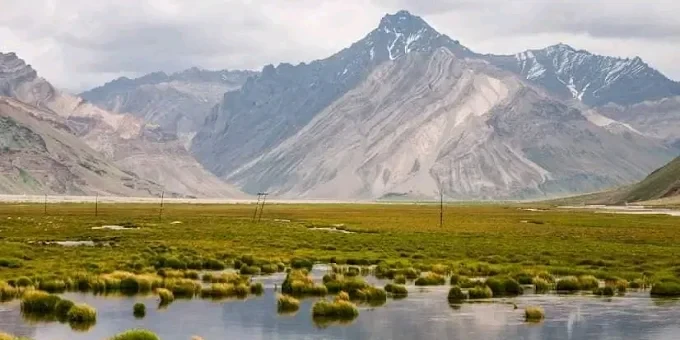
Beginning near Kargil town, the Suru Valley follows the winding path of the Suru River toward Penzi La Pass. Flowing through one of Ladakh’s harshest terrains, this stretch bursts into life thanks to steady water supply. Instead of rocky emptiness, you find lush crops - barley bends low here, alongside buckwheat and rows of apricot trees. Towering above, sharp ridges hold up giants: Nun stands at 7,135 meters, while Kun rises just behind at 7,077. These peaks belong to the Greater Himalayas, their snow-covered crowns glowing under strong sunlight. Though surrounded by desert-like terrain, this pocket thrives. Connecting remote Zanskar, the route beyond Penzi La feels more like a quiet threshold than a barrier. Homes dot the valley where Muslim and Buddhist families keep old ways alive. Beauty pulls many here - yet others come chasing climbs, long hikes, or nights under open sky near Nun-Kun. Mix traditions, rich soil, high grasslands, white summits - and few spots feel quite like this. How does green stay so strong amid Ladakh’s dry stretch? This place holds answers without trying. Thrills wait quietly; peace settles just as deep for anyone willing to look.High walls of rock shaped how life unfolded in Suru Valley, while shared customs moved through as travelers passed along old mountain trails. Farming patches clung to rich soil where families drew water from the Suru River - remains found nearby show they stayed for centuries. Green folds of land stood out across Ladakh’s dry stretches, drawing people toward a landscape lush enough to build homes. Beliefs shifted slowly here: temples came first, then mosques appeared, both leaving marks seen even now in everyday ways. From the 8th to the 10th century, Tibetan Buddhism made its way into the valley as part of a wider movement across Ladakh. Over time, locals began constructing their own temples - also turning earlier structures into hubs for study and prayer. Then came shifts: Muslim leaders pushing west helped carry Islam into the region. Early influence arrived through contact with nearby Kashmir and Baltistan before shaping local culture more deeply. Today, most in the Suru Valley follow Islam, though Buddhist groups remain in surrounding zones, holding fast to ancestral ways. Different beliefs exist side by side, shaped not by conflict but quiet sharing of space. Farming thrived in the Suru Valley because the soil worked well for growing crops. Moving beyond geography, Zanskar and Kargil linked smoothly to both Ladakh and Kashmir through that same passageway. Those tilling the fields weren’t just feeding families - caravans crossing rugged trails relied on their harvests. Travelers trekking long distances found meals waiting thanks to village hands working the earth. Routes stretched far, yet sustenance came from close at hand. Nature lovers frequently visit Suru Valley through our Leh Ladakh Tour Package to experience green landscapes and mountain views.Nearby Places around Suru ValleyNun-Kun Peaks: Towering above eight thousand meters, the pair - Nun at 7,135 and Kun just behind at 7,077 - rise like sentinels across the western Himalayas, shaping how Suru Valley looks from below. Climbers travel far and wide, drawn by steep slopes and crisp air, testing their skill against these heights. From down in the valley, even those who stay on flat ground catch sight of snowy crowns glowing under sunlight. What stands out most is how white peaks cut through morning mist, quiet yet impossible to ignore.Parkachik Glacier: Not far from Kargil - around 70 kilometres - a glacier called Parkachik lies beneath the towering Nun-Kun peaks. Among Ladakh’s icy giants, this one stands out for how reachable it feels. Step onto its surface, and jagged ice sculptures greet you under an open sky. Hikers often wander here, drawn by paths that weave through raw alpine terrain. Mountains loom nearby, their heights cutting into thin air where few venture. Close enough to touch wildness, yet surprisingly straightforward to reach.Shafat Village: A stretch along the Suru River holds Shafat, sitting quietly under open skies. Fields painted green fill the view here, almost like strokes across uneven ground. Apricot trees rise in rows, common enough to seem part of the air itself. Life moves slowly, shaped by how Ladakhis have lived for generations. Old ways of farming still take root in these plots, passed down without need for change. To some, it stands as proof of lasting practice; to others, just a place where time feels different.Kargil Town: Kargil Town sits roughly sixty kilometers away from Suru Valley. This spot handles regional governance duties. Visitors find lodging options here along with stores and chances to experience everyday life up close. Another thing - travellers usually start their trips toward Suru Valley and the Nun-Kun mountain pair from this location.Best Time to Visit Suru ValleySummer (May to September): When summer arrives - between May and September - it becomes the best moment for a trip to Suru Valley. Temperatures sit between 15°C and 25°C, so activities like walking through trails, looking around scenic spots, or trying climbs feel just right. This season paints the valley in rich greens; besides that, paths open up fully, reaching even remote glades and villages.Monsoon (July to September): When rains arrive between July and September, Suru Valley stays mostly dry due to its sheltered position. Still, showers pop up now and then. Greens grow richer by the week, because water fills every stream and cascade. Roads remain open most days, although wet weather sometimes slows things down for short stretches.Winter (October to April): Snow blankets the valley starting in October, staying through April. Cold settles in hard, often dropping past –15°C. Roads disappear under thick layers, cutting off access. Because of this, adventure plans slow to a stop. Yet peace takes over when everything turns white and quiet. Some travellers seek out these hushed moments instead. Stillness replaces motion, beauty hides in simplicity.How to Reach Suru ValleyBy Airport: The nearest landing spot is Kushok Bakula Rimpochee Airport at Leh - about 200 kilometers from Suru Valley. Planes arrive here from Delhi, Srinagar, plus a few big hubs. Once in Leh, visitors might drive themselves or tag along on an organized trip toward the valley. Reaching Suru Valley usually follows that path.By Road: Suru Valley lies ahead when traveling via NH1, starting out from Leh or coming through Kargil. Following the Suru River beyond Kargil, views unfold toward Padum and onward to Penzi La. With mountains nearby, water below, homes tucked close by, each mile passes slow yet steady. Though peaceful, time spent on road shifts day to day based on what unfolds. Journey stretches just enough before arrival crests into sight.By Railway Station: Near the railway station: No train route leads straight into Suru Valley. The nearest big rail hub sits about 700 kilometers off - Jammu Tawi. Reaching Leh by air becomes possible once you arrive in Jammu. Otherwise, a road journey begins there, winding north via Srinagar, then onward past Kargil toward your destination.