

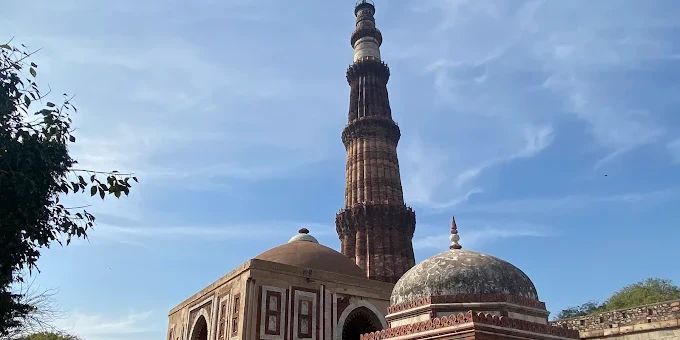
Standing tall at 73 meters, the Qutub Minar ranks as the world’s highest brick minaret. UNESCO honors it as part of the World Heritage list, a nod to its deep cultural value. This monument shines as one of India's grandest, reflecting styles born from Indian-Islamic fusion. Red sandstone forms much of its structure, later accented with marble embellishments. Carved patterns cover its surface - some drawn from verses in the Quran. Five distinct levels rise upward, each marked by balconies jutting out in turn. No two floors look alike; changes in design unfold as eyes move skyward. Nearby lies the wider Qutub Complex, home to several ancient landmarks. Among them stands the Quwwat-ul-Islam Mosque, an early stone mosque on the subcontinent. Also present: the elegant Alai Darwaza, known for fine craftsmanship. Then there’s the Iron Pillar, defying time and corrosion through sixteen centuries. Delhi draws crowds to many sites - but here, just behind India Gate in popularity - it pulls steady footsteps. Outside the monument, green lawns spread out quiet beneath your feet. A pause like this feels different after hours on Delhi's busy roads. These days, Qutub Minar still stands with old stones shaped by long-gone hands. So most visitors find their way there when tracing the city’s past.Started in 1192, the construction of Qutub Minar began under Qutb-ud-din Aibak, ruler of the newly founded Delhi Sultanate, following his win against the Rajput rulers. Though he laid the foundation, only the lowest level stood when his rule ended. Then came Iltutmish, who took charge after him - also linked by marriage - expanding upward with three additional levels. Much later, during the 1300s, that same leader completed what became the final, fifth tier. Built as a sign of Islamic dominance in the region, the structure doubled as a symbol of military success. Standing near the Quwwat-ul-Islam Mosque, which holds the title of India’s earliest mosque, its walls bear carvings showing how stones were reused from fallen Hindu and Jain places of worship. Back then, storms struck often - lightning cracked down, quakes shook the ground - the minar stood through it all. Each ruin brought repair, hands returning stone to place under shifting rulers’ watch. Around it, buildings rose slowly: a dome took shape, then the tall Alai Minar, followed by the arched doorway called Alai Darwaza, schools forming circles nearby. These weren’t just walls and roofs - they showed how culture grew when ideas met on Delhi soil. Today’s tower speaks without words, holding stories of faith first planted here, carved lines showing where Indian craft joined Islamic form.Nearby Places to Visit Qutub MinarMehrauli Archaeological Park: A stretch of trees and grass sits beside the Qutub Minar, where old walls and quiet pathways tell stories from long ago. Stone steps lead down into forgotten water tanks, once vital for daily life. Among the leaves stand broken arches, remnants of prayers whispered centuries back. Rulers passed through here, leaving marks in carved stone and silent domes. Time folded over itself, layering eras without wiping them clean. You can walk past a tomb from one century, then stumble upon a shrine from another. Each ruin holds a different voice, if you listen closely.Chhatarpur Temple: Just four kilometers from the Katyayani shrine sits Chhatarpur Temple - dedicated to the Mother goddess. Though built relatively recently, its sprawling grounds rank it one of India’s biggest temple clusters. This place of worship draws countless visitors each year without seeking attention. Size alone doesn’t explain its quiet presence amid Delhi’s chaos. Stone pathways wind through shrines where stillness feels deliberate. Where devotion gathers slowly, like light at dawn.Lotus Temple: A bloom shaped like water lilies guides your path from Qutub Minar toward the quiet grace of the Bahá'í temple - twelve kilometers stretch gently ahead, smooth under tires. Roads unfold flat and clear, leading past small shops and trees leaning into breezes. This place wears its meaning softly, rising like folded petals touched by light. Travel time floats just above twenty minutes when traffic flows loose. Each turn brings stillness closer, layer by layer peeling away city noise.Hauz Khas Village: A short ride from the city center - about seven kilometers - and Hauz Khas Village comes into view. Ruins stand beside modern life here, where old blends with new without effort. A quiet lake reflects sky, trees, and people walking by. Trendy cafés hum during afternoons while small shops sell clothes, crafts, handmade things. Art spaces show local work on walls that once saw empires fade. Life moves at its own pace, neither rushing nor stopping. Past echoes underfoot, yet laughter fills the air above ground.India Gate: Looming large near the city's heart, India Gate stands fifteen kilometers away from Qutub Minar. Evenings bring crowds who wander close, drawn by open spaces that quiet the mind. While built to honor soldiers lost in battle, it now hums with calm, becoming a spot where light breezes mix with slow footsteps.Best Time to Visit Qutub MinarSummer (April to June): Hot months run from April to June in Delhi, when temperatures often hit 40°C. Because of the intense heat, daytime travel isn’t practical. Instead, mornings or evenings offer a better experience then.Monsoon (July to September): When July arrives, rain wraps around the Qutub Complex, making it lush, alive. Still, sudden downpours might catch someone off guard while walking through. Though greenery thrives under wet skies, moving about becomes tricky now and then. Heavy drops fall without warning, slowing each step along the paths.Winter (October to March): During winter, from October through March, temperatures often stay between 10 and 20 degrees Celsius. That kind of mild chill makes walking around feel just right. Sightseeing at landmarks nearby doesn’t wear you out when the air is this gentle. Cold snaps happen, sure, yet many days surprise you with warmth.How to Reach Qutub MinarBy Airport: From the airport, reach Qutub Minar via Indira Gandhi International - roughly 12 kilometers down the road. Instead of waiting, hop on the metro right after landing. Taxis work too, especially if luggage weighs you down. Ride-hailing cars stand ready through apps moments after arrival.By Railway: The closest big hub sits 17 kilometers away - New Delhi Railway Station links well across India. Not far off, about 15 clicks east, Hazrat Nizamuddin offers another stop along the rails.By Road: You can usually find local transport like buses, cabs, auto-rickshaws, or ride-hailing cars around most areas in Delhi that link up with big routes leading toward Qutub Minar. Just two kilometers away sits the Qutub Minar metro stop - part of the Yellow Line - making rail travel quick and straightforward.