

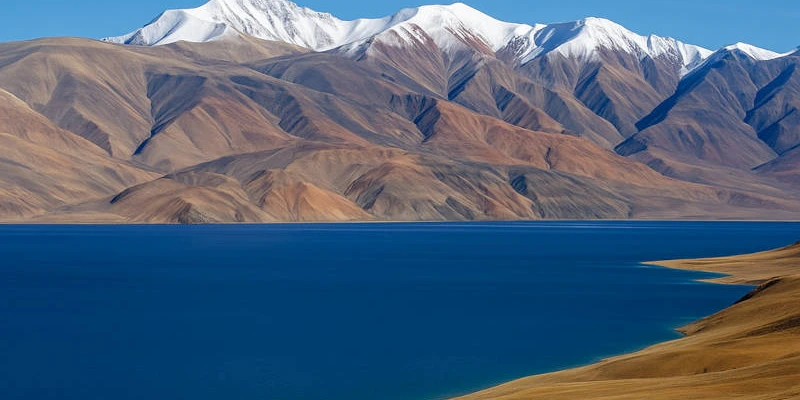
High up in Ladakh’s Changthang valley sits Tso Moriri, known as The Mountain Lake. At nearly 4,522 meters above sea level, it holds the title of India's biggest inland high-altitude lake. Snowy summits rise behind it while wide dry stretches spread out nearby. Beauty here feels untouched - calm, quiet, yet striking. Photographers find stillness in its reflections, travelers pause at its edges. It breathes life into rare plants and animals found nowhere else. Each year, winged visitors arrive during migration seasons, adding movement to this fragile reserve. Blue waters stretch far, bouncing back images of towering cliffs like liquid sky. People drawn to raw landscapes often end their journey here, standing silent before what feels ancient and whole. Out here, space stretches wide between human traces. Only a handful stay, like the Changpa, moving across distant pastures under old rhythms. Though small in number, their presence holds steady through seasons of grazing and prayer. Near them rests Tso Moriri, water shining with quiet meaning. Locals speak of it as sacred ground - untouched, watched over. Close by stands Korzok Monastery, rising quietly beside the shore. That place guides daily life, drawing both villagers and travelers into its orbit. Distance keeps crowds away; roads twist long before arrival. Yet what waits feels unspoiled, shaped by silence and sky. Nature shows itself gently there, slow and open. Traditions pass down without noise or rush. Visitors find more than scenery when they arrive. Being at Tso Moriri means stepping inside a world carved by altitude, wind, and custom. Life moves differently where thin air shapes each breath.Tucked into the rugged terrain of southeast Ladakh lies Tso Moriri, shaped by more than just natural forces. Its story ties closely to the wide open spaces where wind sweeps across barren hills. People known as the Changpa moved here with animals they depended on, shifting camp when seasons changed. For generations, these movements followed ancient rhythms tied to survival in thin air. Life near water meant careful steps so fragile surroundings stayed intact. Long before modern records, monks and villagers saw such lakes as different - touched by silence and unseen presence. Over time, belief wove itself into daily life around Tso Moriri. High-altitude waters like this one carried weight in old tales spoken beside fires. Not every place could hold such stillness; few felt truly alive without sound. Respect grew quietly, passed down through gestures rather than words. Mountains watched while rituals formed slowly under vast skies. Long ago, some monasteries rose across the high plains - Korzok stands nearest to where Changpa herders gather, along with Buddhist travelers honoring old traditions. Rituals once echoed through its halls, meant not just for peace but also to guard the earth, creatures, and those relying on the waters nearby. Even under brutal skies, Tso Moriri holds steady as a lifeline deep within the Himalayan stretch. Life thrives here - not alone, but woven together: fish dart beneath flocks, wings pass overhead each season, nests form in quiet corners, all fed by one unbroken cycle. Traders once moved west to east, pilgrims followed sacred paths - the lake marked their way between Ladakh and distant Tibet, records now confirm. Travelers seeking breathtaking lake views often choose our Leh Ladakh Tour Package, which includes the stunning Tso Moriri Lake.Nearby Places around Tso Moriri LakeKorzok Village: West of Tso Moriri Lake sits Korzok Village, tucked along its northwestern shore. High in the mountains, this place shelters Changpa nomads who’ve settled into village routines, not just seasonal movement. Daily rhythms revolve around yak herding, a practice woven deep into existence here. Rising above it stands Korzok Monastery - central to faith, culture, and identity for locals. Though quiet ways have held strong across generations, the monastery remains the beating heart of tradition in these parts.Korzok Monastery: Not far from the quiet waters of Lake Tso Moriri, hidden for centuries, rises Korzok Monastery - its presence known only since recent times. This place stuns those who arrive, standing out even amid such wild beauty. Locals gather here often, their voices rising in prayer, while travelers pause to watch rituals unfold under open skies. Though remote, it draws people in, not just for faith but for color - the walls lined with painted stories, shapes fading slowly through time. Stillness wraps around the buildings like cloth, softening every sound. Visitors linger longer than they expect, pulled by something beyond sightseeing. Architecture plays its role too, old yet strong, shaped by hands long gone. For many, it feels less visited and more discovered, each step forward revealing another layer.Sumdo Village: A stretch of mud-brick houses appears just before the climb begins - families of Changpa herders live here, tending sheep near low stone walls. This place, called Sumdo, sits where roads stop and footpaths start toward Tso Moriri. Travelers pause by small shops stacked with dried cheese and wool caps, their boots dusty from long drives. A handful of guest rooms wait beside prayer flags fluttering above narrow lanes. The air thins quickly once you move past these clusters into open sky.Pangong Lake (Optional Nearby Attraction): Far from the usual paths, a striking lake sits high up in Ladakh - Pangong. Roughly 220 kilometers distant, it draws attention just like the others do. Travelers often find themselves at both lakes when chasing different views across the region. Instead of endless rocks and dust, they meet clear blue waters that surprise the eye. One moment you’re surrounded by dry peaks, next you're staring into shimmering reflections with no sound but wind.Best Time to Visit Tso Moriri LakeSummer (June to September): Around June through September, Tso Moriri Lake comes alive under clear skies. Between ten and twenty degrees, the air stays mild enough for long walks across open trails. Instead of harsh cold, visitors meet gentle breezes carrying mountain silence. Roads reach farther now, opening paths once blocked by snow. Bright waters mirror rocky peaks like glass shaped by nature's hand. Wildlife moves more freely, seen near shorelines when sunlight tilts low. This stretch offers what others cannot - calm days beside a lake glowing beneath wide horizons.Monsoon (July to September): Rainy weeks arrive between July and September. Though much of the land stays arid, sudden downpours do appear now and then. Sunshine still breaks through often enough. That light works well for those taking pictures or spotting birds. Travel flows easily on many stretches. Yet certain sections slow things down when paths turn muddy and rough.Winter (October to May): Cold bites hard here between October and May. Frost often drops near minus twenty Celsius at Tso Moriri. Snow piles deep, roads shut tight during these months. Because of blocked paths, few reach the lake or nearby lands. Still, when white blankets stretch across the terrain, silence grows thick. That stillness pulls some travelers in - those who chase quiet, those drawn to raw wilds.How to Reach Tso Moriri LakeBy Airport: That's Kushok Bakula Rimpochee in Leh - nearest to Tso Moriri - sitting roughly 220 kilometers away. Travelers roll toward the lake after landing, choosing either a car or a bus out of Leh, since flights link this spot with Delhi, Srinagar, and Chandigarh.By Road: Starting from Leh, a journey toward Tso Moriri unfolds through remote Changthang settlements like Mahe and Sumdo. Travelers rolling by vehicle usually spend close to eight or ten hours reaching the destination. Scenery along the route brings wide mountain views, deep valleys, followed by vast open plateaus sitting high above sea level. Instead of driving solo, many opt for group rides in taxis, hire personal cars, or join guided trips arranged ahead of time.By Railway Station: From the railway stop: Travelers cannot hop on a train straight to Tso Moriri. Jammu Tawi rail hub sits roughly 463 miles (750 km) away from the lake - nearest you’ll get by track. Flying into Jammu and Kashmir works better, followed by road travel via vehicle or coach toward the water