


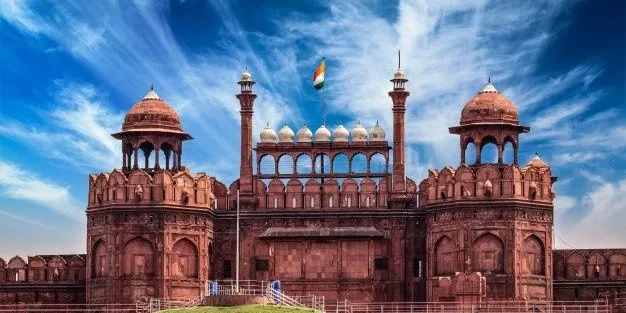
Standing tall in Old Delhi, Red Fort ranks as one of India’s seven wonders and holds UNESCO World Heritage status. Not just a centerpiece of historic Delhi, it stands as an elegant example of ancient design and construction. Picturesque buildings within reflect the grandeur of the peak Mughal era, shaped under imperial rule, while remnants of a metropolis once ringed by nearly 2.5 kilometers of red stone still remain visible. Instead of royal residences alone, visitors find open courts for gatherings, sculpted green spaces, and ornate entrances hinting at a fusion of Persian, Timurid, and local craftsmanship. Around now, this spot does more than entertain travelers - it stands for India breaking free, which explains why the country's leader climbs up to raise the flag each August. As darkness falls, a nighttime performance brings old battles to life, turning the grounds into something unforgettable after sunset. People line up nightly because the show sticks with them long afterward.Starting in 1638, Shah Jahan wanted a new beginning - shifting power from Agra to Delhi sparked the birth of the Red Fort. Nearly ten years passed before walls rose tall enough to call it done - completion came quietly in 1648. From then on, day after day for two centuries, life inside throbbed with politics and ceremony under Mughal rule. Known first as Qila-i-Mubarak, its halls echoed stories shaped by rise, fall, rebellion - not just stone but memory. Ustad Ahmad Lahori, who shaped the Taj Mahal, took charge of designing the Red Fort too. Within its inner chambers rested the Diwan-i-Khas, meant for private meetings, alongside the Diwan-i-Aam and delicate marble residences beyond words. When rebellion struck in 1857, British forces seized control and razed much of what stood inside. Still today, the structure holds firm - echoing India’s heritage and enduring spirit across the years. Since being listed by UNESCO in 2007, visitors drawn to history have wandered these grounds, tracing layers of meaning through stone and silence.Nearby to Visit Red Fort (Lal Qila)Jama Masjid: Not far from the Red Fort stands Jama Masjid, one of India's largest mosques, raised under Shah Jahan’s rule. Its sweeping courtyard stretches wide beneath towering minarets, impossible to overlook. Grand design marks every corner, shaping an impression that lingers long after you leave.Raj Ghat: A stone path leads away from the old walls toward a still space where silence settles like dust. There you find Raj Ghat, honoring Mahatma Gandhi with simplicity. Instead of grand statues or loud signs, just a dark slab rests - smooth, uncarved, heavy with memory. This open-air shrine sits about two kilometers from the fortress nearby. The place breathes calm. Because here, in January 1948, flames carried him onward. Since then, visitors step lightly across the ground.India Gate: Standing tall near lush green spaces, India Gate honors troops lost in battle - located roughly five kilometers away. Evening crowds often wander close, drawn by open lawns that circle the structure. Not built just for looks, its presence marks sacrifice, making it a quiet favorite once daylight fades.National Museum: Right by Rajpath sits the National Museum. Inside, treasures from across India fill the halls - old writings appear beside colorful art. Sculptures stand close to rare documents. A wide mix of history lives within these walls. You will find few places like it, where culture shows itself so openly.Best Time to Visit Jama MasjidSummer (April to June): Hot months arrive between April and June. Most days, Delhi hits above forty degrees Celsius. When things get rough, touring early morning or late evening stays manageable.Monsoon (July to September): When rain comes between July and September, everything feels fresh. Trees turn lush near the old walls during these months. Wet days bring chill air that wraps through the stone paths. Still, sudden downpours might stop what you had arranged.Winter (October to March): Cold months arrive early, stretching from October through March. Temperatures settle between 10 and 20 degrees, just right for walking around. Crowds show up in full force during this stretch, drawn by steady weather. Exploring the old fort feels easier when skies stay clear.How to Reach Jama MasjidBy Airport: From the airport, reach Red Fort via Indira Gandhi International Airport, just about 20 kilometers off. A ride on the metro works well, though taxis wait ready. Cabs also run regularly toward the monument.By Train: Heading into the Red Fort by rail? Old Delhi Railway Station sits just 2 kilometers away, a key hub tied neatly to destinations across India. Another option pops up nearby - New Delhi Railway Station, roughly 6 kilometers out - making access smooth without fuss.By Road: Most parts of Delhi connect easily to Red Fort by road. Reaching there poses no difficulty when riding local buses, autos, or cabs. Not far off, the Chandni Chowk metro stop sits on the Violet Line. Walking from that station takes only a few minutes.