

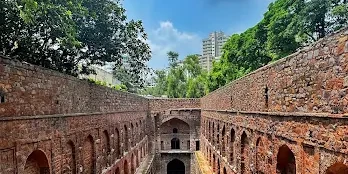
Below the hush near Connaught Place rests Agrasen ki Baoli, a weathered stepwell thick with memory. Though once tied to King Agrasen’s time, it rose anew by the work of Agrawal builders in the 1300s. Sixty meters it stretches, fifteen across, carved downward through 108 steps leading to unmoving water beneath. Rising beside it, high stone walls hold arcs of niches where sunlight slips, meeting shade without sound. A whisper runs through Agrasen ki Baoli, pulling without force. Echoes linger where water once slipped down ancient steps. Constructed centuries back, it held monsoon drops, giving rest beneath fierce suns. Now, silent figures in uniform watch each crumbling edge. Visitors arrive anyway, lured by layers of history etched into rock faces. Where shadows stretch thin across stone, movement begins without reason. Now and then a camera shows up, holding still moments of places half seen, yet fully noticed.Water once reached these stone stairs, carved deep into earth - this is what people called a baoli. Stories whisper of King Agrasen, or maybe merchants named Agrawal, though stones tell of Lodi hands shaping it centuries later. Step by step, the descent unfolds under shaded arches where old temple lines meet quiet echoes of mosque artistry. Craftsmen likely moved between faiths, leaving marks neither pure nor fixed but blended through time. Not many records remain, just guesses held together by worn inscriptions and silent walls. Yet this place helped Delhi breathe, feeding crowds while anchoring community moments beyond mere function. Its presence hints at planning older than maps, rooted in rhythm rather than rule. Slowly, over days, Agrasen ki Baoli started falling apart - that was before the Archaeological Survey of India stepped in. From that point forward, attention never faded, kept alive by steady work. More than a working ancient stepwell, it shows how smart city planning once shaped life here. With calm presence, it shares whispers of Delhi’s past, revealing resourcefulness from forgotten times.Nearby Places to Visit Agrasen ki BaoliConnaught Place: A few steps lead to Connaught Place, humming with movement. Along the roads, stores pop up one after another, each hiding something new. Food wakes up taste buds in ways you might not expect. From café doors, voices rise, mixing with chatter in wide-open spaces. Through narrow lanes, tunes float past crowds staying long after dark. Streetlamps wake up as dark falls, making pavements feel like sets. Here, seconds stretch, though clocks rush ahead.Jama Masjid: A stone's throw distant, about two kilometres out, rises Jama Masjid - India’s largest mosque, steeped in time. History hums softly close to its high walls.Red Fort (Lal Qila): Just beyond Agrasen ki Baoli, about three kilometres off, sits the Red Fort. Not many miss it when they walk through Old Delhi - its size draws people in. Made of red sandstone, it rises large and hard to ignore. The walls have stood long enough to earn a spot on UNESCO’s list. What remains now is more than old stone - it's part of something wider, older.Gurudwara Bangla Sahib: A short walk leads to Gurudwara Bangla Sahib, where sunlight catches on a gilded rooftop. This busy Sikh shrine pulls crowds without trying. Each day, food flows from a vast cooking hall, shared freely among those passing through. For countless individuals, the ground feels sacred. Open arms define the space - worship blends quietly with generosity.St. James’ Church: A few steps off, St. James’ Church rises, shaped by colonial hands long ago. Time settles around it, soft but steady, in the lanes of Old Delhi. Unshouting, still heavy with what came before. Old bricks hold stories nobody tells out loud. What stands here now began long before today.Best Time to Visit Agrasen ki BaoliSummer (April to June): Early hours bring a slight chill once April starts. Come later afternoons, shade grows thin as paths soften beneath harsh daylight. With June comes climbing rays - above forty at times. Such brightness shifts exploring to quieter parts of the day.Monsoon (July to September): Come July, rain begins to fall, easing the hot stretch until September rolls in. Without notice, heavy clouds arrive - schedules adjust as showers take hold. Muddy trails make walking slower at times when exploring outside. Plants grow fast beneath daily waves of afternoon storms. When thunderheads build above, movement across areas changes pace.Winter (October to March): When winter rolls in, usually by October, it stays put through March - ideal for showing up. Clear skies tend to stick around, making day trips easier without fuss. Temperatures hover between ten and twenty degrees, which means wearing layers does the trick. Mornings call for light clothing, yet a heavier top becomes useful after sunlight fades.How to Reach Agrasen ki BaoliBy Airport: Touching down soon? The airport you want is Indira Gandhi International, code DEL - roughly 17 kilometers away from Agrasen ki Baoli. After stepping out of arrivals, different rides wait: take a taxi if that suits, grab a cab instead, or head underground for the metro.By Railway: Folks riding trains can reach New Delhi station in barely 3 kilometers. A bit beyond that, around 5 clicks away, stands Old Delhi station. Getting to either opens doors straight into cities all over India. From here, tracks stretch out, touching each edge of the country.By Road: Walk there if you're already near Rajiv Chowk Metro Station. Getting around by bus works fine during daytime hours. Taxis booked through apps arrive after a few minutes usually. Auto-rickshaws rattle along side streets, weaving past slower vehicles. Driving yourself means navigating narrow lanes off main roads. Those choosing public transit often find the subway faster than sitting in traffic.