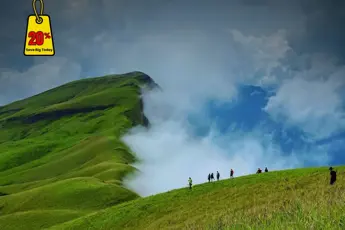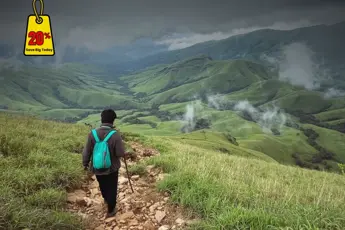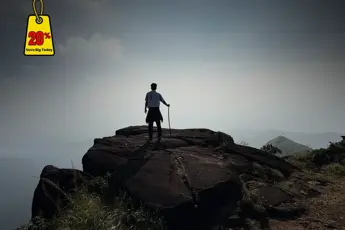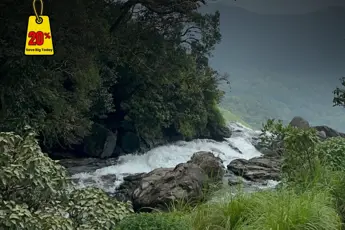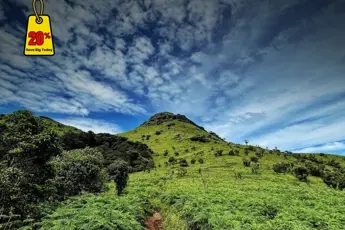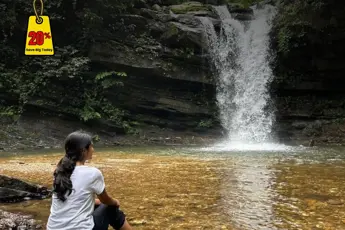

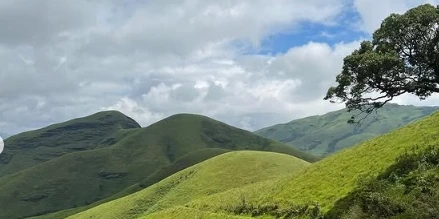
Kudremukh National Park is a big and unbroken national park in the state of Karnataka, covering an area of around 600 square kilometres. The national park was established in 1987. The national park is richly diverse with tigers, leopards, wild boars, gaurs (Indian bison), and sloth bears present in the park. There are a few endemic birds that reside in the park, including the Malabar whistling thrush and the great Indian hornbill. The park has been blanketed with dense evergreen and tropical shola grasslands and large rolling grassland cover. It is also within the broader Western Ghats region of biodiversity hotspots, and in a manner, regional ecological balance would be served. Several rivers, Tunga, Bhadra, and Nethravathi, take their origin from the Kudremukh plateau, and thus, it is primarily a major watershed of Karnataka. Tourists can hike on its many hiking trails, except for the Kudremukh trek. Scenic waterfalls like Hanuman Gundi Falls and Kadambi Falls border the park and are frequented by nature enthusiasts and photographers. Contrary to the majority of other Indian national parks, Kudremukh National Park is relatively less ravaged, and it is a serene and virgin home for nature enthusiasts and adventure enthusiasts. For the religious and culture-minded, Kalasa town is close to the Kalaseshwara Temple of Lord Shiva. It is an ancient and pilgrimage town, and this provides a religious touch to the hill. Trekking within the park is controlled by the forest department in an attempt to protect its delicate environment. An entry permit is given, and trekkers are also requested to exhibit ecologically supportive tendencies like non-littering and leaving smaller footprints. It is a destination that provides the best mix of adventure, nature, and ecological attractions. If it is an adventure trekker, a nature lover, or even a commoner who wants to seek peace among nature, there is something for everyone at peak. Its breathtaking scenery, diverse biodiversity, and rigorous trekking routes are all reasons that one simply cannot afford to miss for all lovers of nature. Amongst Karnataka's most valuable natural pearls, It is a wonder and marvel to anyone who would care to behold its unspoiled beauty. Nature lovers can explore more mountain adventures through our Treks Near Bangalore guide.Best Time to Visit KudremukhKudremukh is one of the Western Ghats' scenic hill ranges of Karnataka, which is one of the finest trekking destinations in South India. Famous for its green hills, meadows, and rich flora and fauna, it is a nature lovers' and adventure sports enthusiasts' paradise. But timing matters to ensure the trekking tour is safe and enjoyable. The best time to go to the hill is usually monsoon and post-monsoon, when the state is heaven with gushing streams, misty valleys, and greenery all around. Seasonal differences and their effect on trekking will enable you to commute more comfortably.Seasonal Differences and Their Effect on TrekkingIt experiences three seasons – summer, monsoon, and winter. All three are varied and affect the entire trekking process.Summer (March to May)Summer is fairly hot at hill , with daytime temperatures ranging from 25°C to 35°C. Evening and morning are pleasant, but afternoons become swelteringly hot, tiring out long hikes. Humidity is also very high, which also makes the trek more challenging. The dry climate is the kind that will not support new vegetation to provide cover for the trails, and water sources within the trail will vaporize, so it would be difficult to accumulate sufficient water. Other than this, animal encounters are also less likely because the animals will take shelter under the sun. Summer is not ideal for trekking but early morning treks during morning hours are feasible by the heat-tolerant ones.Monsoon (June to September)Monsoon is the most enchanting transition of hill Rain showers make the area a green and dense jungle, with new streams, and foggy valleys. Monsoon temperature is 18°C to 25°C, cool and pleasant weather to trek. The path, however, is slippery and dangerous to walk, as it rains heavily. Leeches are also very prevalent during the season, and therefore precautions like full-sleeve dressing and the use of anti-leech socks or spray must be adhered to by the trekkers. Monsoon, with all such issues, is the ideal time for nature enthusiasts to go to peak.Post-Monsoon (October to February)Post-monsoon is usually the best season for trekking to the peak. When the monsoon withdraws, the terrain remains lush green but the trails dry out and get more exposed. The weather also is extremely good with 15°C to 25°C temperatures, providing the perfect mix of cold air and sunlight. The chances of icy tracks are nullified, and the trek is safer and easier. The waterfalls and streams remain gorgeous, and visibility is not lost, providing stunning panoramic vistas of the hills and valleys around. You will be able to see wildlife as well, as the wildlife will come down when the weather is good. Birdwatchers can have a possibility of seeing a mix of endemics and fly-ins at this time. Even morning and evening are foggy, so the atmosphere in which the trek happens is spooky. Post-monsoon is perfect for beginners and experienced hunters alike as the trails are not tough and picturesque enough nor are the monsoon rains and blistering summer.Trekking Route and Trail Details: Kudremukh TrekKudremukh Trek, Karnataka's prettiest and most popular trek, provides adventure lovers with a thumping blend of demanding trails, picturesque landscapes, and a peaceful backcountry. Located at the heart of the Western Ghats, Kudremukh or "Horse Face" locally so named got its name from the horse-face-shaped crest at the top. Strolling in the forests, rolling hills, and open brooks is a memory to cherish. A step-by-step description of the trekking trail, start point, interesting landmarks, and likely setbacks is given. Start Point: Mullodi Village and Permissions Needed. The trek starts at Mullodi, the base village. The trekkers have to go to Mullodi initially, and for this, they have to go to Kalasa, which is a town in the Chikkamagaluru district. A 6 km jeep ride over a bad road from Kalasa takes one to Mullodi because the road is not motorable. As it lies within the Kudremukh National Park, the Kudremukh trek is governed by forest department clearance. Permits are handed out close to the entrance gate on Mullodi. The day trekkers are restricted by the forest department so that biodiversity of the area is not harmed. Apart from that, plastic is not allowed and they are asked to make use of biodegradable materials so that nature is not destroyed. Apart from that, only in the evening till dawn, i.e., between 6 AM and 6 PM is a day trek allowed so that there will be sufficient time for the trekkers to reach the destinations before sunset.Glitzy Break-up of the Trek: The overall trek distance is approximately 22 km (11 km in a single direction) and it would require approximately 6-8 hours to reach there, depending on the pace at which the trekkers ascend and the weather conditions prevailing at that time. The trail is from an altitude of 1,200 meters (3,937 feet) at Mullodi to 1,894 meters (6,214 feet) at the summit of peak . The trail is moderately strenuous with a combination of grassland, thick forest cover, and sloping land. Trekking is segment-wise as given below:Mullodi to Forest Entry Gate (1 km): The hike officially starts from the forest department checkpoint, i.e., 1 km from Mullodi village. Trekkers need to produce permits here before proceeding. This is an easy part and passes through a mix of coffee plantations and village roads.Forest Entry Gate to Ontimara (4 km): The trek from the checkpost is beneath the cover of trees. The trail is mostly shade, and hence it is a relief walk. Trekkers need to take care in case of leeches, especially during monsoon and post-monsoon periods. The trail gradually goes up until Ontimara (Lone Tree), an open grassy spot with one tree to offer shade. It is a usual place of rest where trekkers stop for a while before proceeding to go up.Zig-Zag Ascent to Ontimara (3 km): The path opens out from Ontimara into sweeping grasslands with a slight slope. There are excellent panoramic views of the valleys below. But the inclination is higher here, and a zig-zag path makes climbing faster. The trekkers must go slow and easy because this stretch can be extremely demanding, especially on hot days.Zig-Zag Ascent to Final Stretch (3 km): Following the zig-zag climb, the last phase of the trek includes back-and-forth small packets of jungle and open ridges. The path is slightly rocky and calls for step-taking care. The top is seen for most of this phase and entices trekking aficionados to desire forcing the last stage of climbing.Climbing the Kudremukh Peak (1 km): The last kilometre is a ridge walk with great 360-degree scenery of the Western Ghats. At the top, the trekker is treated to green undulating hills of emerald valleys, shrouded mountains in mist, and the Arabian Sea on clear days. The hill breeze and serene landscape are worthwhile.Dangers Trekkers Might FaceSteep climbs and endurance test: The Kudremukh is not very challenging, but the rigorous climbs following Ontimara tend to exhaust you. It calls for good endurance and stamina. First aiders should proceed with caution and frequent short breaks.Leeches and Pests: One of the biggest problems, particularly between monsoon and post-monsoon months, is leeches. Leeches are fond of wet forest sections of the path. Leech socks, application of salt or neem oil to deter them, and regular leech checks can minimize the issue.Unpredictable Weather: Weather in the Western Ghats is also unpredictable. Trekkers can have rain, mist, and wind at the top with no prior indication. It is always advisable to carry a raincoat, spare dry clothes, and rain covers for backpacks and gears.Navigation and Time Constraints: As the trek is being done in a national park, night trekking is not feasible. One has to begin very early so that one can complete it on time. Further, the trail consists of many trails, and beginners should consider hiring a guide so that they may not lose their way.Attractions and Activities aroundChikmagalur, the paradise of adventure seekers and nature lovers, offers much more than the popular Kudremukh. It is nestled among green landscapes, coffee plantations, waterfalls, and ancient temples so is ideal for travellers seeking peace and adventure in equal measures. Chikmagalur is a heaven for trekkers too, and many trails provide breathtaking views of the Western Ghats. One of the most sought-after treks, the Mullayanagiri trek, climbs to the state's highest point at 1,930 meters. The trek subjects one to a ride of witnessing fog-covered hills, thick forests, and boulder paths with an adrenaline-pumping but spine-chilling experience. Another thrill-filled trek is the BabaBudangiri trek which takes one through hilly landscapes and green forests with a bird's-eye view of the valleys below. Apart from these, Kudremukh trekking is a treasure of rolling meadows, emerald forests, and horse-shaped hilltops after which it is named. On these trails, tourists can experience the unmatched beauty of Chikmagalur along with whatever they are enjoying in trekking.Coffee plantation tours at Chikmagalur are another attraction that attracts visitors to the place. As the coffee cradle of India, the district boasts extensive coffee plantations that have been developed over centuries. A visit to the plantations provides an insight into the incredible process of producing coffee from the bean to the cup. Individuals can stroll through the green plantations, hear the painstaking process of coffee cultivation, and even indulge in coffee-tasting sessions. Also available in some plantations are stays within the estate, where the guests wake up to the scent of freshly ground coffee against the backdrop of nature's peaceful beauty. The courtesy of the plantation owners and the rural beauty of the plantations is an experience not to be disappointed. For all who are looking for peace and spirituality, temples around and near Kudremukh are a suitable refuge. The Horanadu Annapoorneshwari Temple, located among peaceful hills, is attributed to Goddess Annapoorneshwari and is a holy pilgrim centre. The temple remains filled with peacefulness and devotion, and the devotees make their way from all corners of the world to visit it. Another location within the region that cannot be avoided is the Kalasa Temple, located in the picturesque town of Kalasa. Lord Shiva temples, are replete with superior mythological value and are auspicious and wholesome places for pilgrims. The architectural beauty of the buildings and the serene environment of the temples make them ideal locations for meditation and mental rejuvenation. Discover rolling grasslands and breathtaking Western Ghats scenery with our exciting Kudremukh Trek Package.How to Reach Kudremukh:By Road: Bangalore – ~330 km (7-8 hours road distance) via Hassan and Chikmagalur.Mangalore – ~110 km (3-4 hours road trip). Buses operate between Bangalore and Kalasa, the closest town, and you can hire a local jeep from there to Mullodi.By Train: The closest railway station is Mangalore Junction (110 km from here). You can hire a taxi or bus from there to Kalasa.By Airport: The closest airport is Mangalore International Airport (110 km from here). From Mangalore, you can travel by bus or taxi to Kalasa and jeep to Mullodi.