
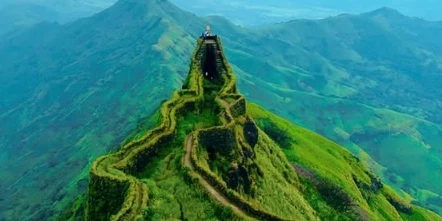
Torna Fort, or Prachandgad, is also one of the more well-documented historically and carries one of the highest rankings of forts in the Pune district. It's been dated back as early as the very earliest, though the fort itself was allegedly constructed by the Marathas during the 13th century. There is evidence to suggest, however, that it had already been constructed by the Rashtrakutas or the Yadavas. The fort became historically famous in 1643 when Shivaji captured it at the age of 16. The first win was a turning point when it came to the establishment of the Maratha Empire. The capture of Torna Fort was an excellent strategic manoeuvre on the part of Shivaji as it provided him with a solid base to further fight the war against the Mughal Empire. It was there that Shivaji Maharaj demonstrated brilliant warfare strategies and proved himself a successful commander, which later came to be the stuff of legend. Historic mountain forts and trekking adventures can be explored through our Treks in Maharashtra pillar guide.Torna Fort also made a significant contribution to the defence of the Maratha Empire. It was constructed on a hill and, therefore, the perfect place to keep an eye on the opposition movement. The fort slowly became less important and began to degrade over time. Today, the fort stands as a monument to history and a preferred trekking destination, frequented by history buffs and adventure lovers alike. Its temple-like ruins of the fort, walls, and gates narrate a story of its glorious past. Its history and its association with the founding of the Maratha Empire have made it an example of strategy and courage even today, and a chapter of the glorious past of Maharashtra. Travelers interested in heritage and mountain trekking often choose our Torna Fort Trek Package.Nearby Places of Torna FortRajgad Fort: Rajgad Fort, located approximately 25 kilometres from Torna Fort, is another ancient fort in the Pune district. It has also been referred to as the "King of forts," and Rajgad was the capital of the Maratha Empire for more than 25 years before Shivaji Maharaj shifted the capital to Raigad. The fort also provides the most scenic view of the place and is famous for having gigantic walls, gates, and temples. Rajgad is an ideal trekking place, and seeing its ancient ruins such as the Rajmachi, Ballekilla, and Suvela Machi. Nature and history combined form a paradise for historians and trekkers.Sinhagad Fort: Sinhagad Fort, located about 30 kilometres from the state capital city of Pune, is a site of interest for trekkers and historians. The Sinhagad Fort, which was replete with history in its war, witnessed the war of Sinhagad in 1670 when Maratha warrior Tanaji Malusare laid down his life to capture the fort for the Maratha kingdom from the Mughal Empire. The fort itself is on a hill and is famous for the stunning view of nearby forts and valleys. The tourists even get to view the bastions, gate, and Tanaji memorials of the fort, and the trekking routes of various types which lead to the fort.Korigad Fort: Korigad Fort is about 20 kilometres from Lonavala, about 60 kilometres from Torna Fort. The fort is located at an elevation of 900 meters and is a moderately difficult hike of fairly easy distance with a view of hills in all directions and the Pawna Lake. The fort is of unusual shape and boasts a very well-preserved rampart and two gigantic gates. It also has a temple for the local deity. Korigad is one of the best options for a tourist who would like to visit a lesser-known fort location with an excellent trekking experience and beautiful scenery.Lonavala and Khandala: Twin Hill Resorts Lonavala and Khandala are 50 km from Torna Fort. Due to its emerald valleys of mountains and waterfalls, along with a pleasant climatic position, twin towns Lonavala and Khandala are Mumbaites' and Puneites' top preference as a weekend destination. Lonavala is very well known for the chocolate plants surrounding it, and Khandala is very well known for staying tranquil. Although these hill stations offer places of sightseeing like Bhushi Dam, Tiger's Leap, and Karla Caves to attract, a day tour or a weekend tour of these stations could be taken on the return trip from Torna Fort.Mulshi Lake and Dam: Mulshi Lake and Dam, both located 40 kilometres away from Torna Fort, are a serene haven in the Sahyadri hills. The lake is a scenic retreat for nature lovers and photographers alike, where they are exposed to water and leaves. The dam supplies water to the region, and the location is the ideal place to spend an afternoon in nature's arms. The tourists can relax with a serene boat ride on the lake, nature walks, and can also visit local waterfalls nearby, so it is an ideal spot for a serene retreat after hiking to Torna Fort.Matheran: Matheran, which is around 75 kilometres from Torna Fort, is a popular hill station in the country because of its green surroundings. It is one of the very few places in India where driving any vehicle is prohibited, and therefore it is a perfect holiday spot for tourists who want to spend a peaceful, motor-free holiday. It is surrounded by thick forests, and many viewpoints like Panorama Point, Echo Point, and Louisa Point provide panoramic views of the Western Ghats. It is ideal for a relaxed walk or short trek, and tourists can even stop by the local market nearby to purchase some local handicrafts and products like fruits and vegetables.Best Time to Visit Torna Fort TrekWinter Season (October-February): Torna Fort receives its peak season of visitation during winters, i.e., October to February. The climate here is also cold and pleasant during this time, and therefore, it is the best time for trekking. The weather is fine too, with day temperatures between 15°C to 25°C, and hence it's a good trekking time. The weather is pleasant, and the scenery is good with views of the surrounding Sahyadri hill ranges and surrounding forts such as Rajgad, Raigad, and Sinhagad. The weather is pleasant and the scenery is excellent, and the trekker can enjoy the scenery in between and also of the fort from the summit.Post-Monsoon (September to Early October): While the monsoon months of June, July and August are too wet, September and early October are also good for trekking. The road is green and tropical with waterfalls flowing freely on the road. The weather begins to become moderate after summer, and it is a good period to trek. The trekker must be cautious, however, since the roads are slippery due to the rain marks, particularly on the incline part of the road.Monsoon (June to August): The monsoon season at Torna Fort is a disadvantage, but provides scenic beauty to certain trekkers who cannot be provided by any season. The whole landscape is a paradise of thick fog, mist, and waterfalls flowing over the cliffs. The fort, along with trekking, is draped with an overcoat of greens, and therefore it's a picturesque place to view for nature enthusiasts as well as for photographers. But it is not so wise to ascend here at this time of the year to start with because the trails are slippery and risky, and the weather is not so reliable, and hence the view is an issue. It is wise to be well-prepared and take precautions.Summer (March to May): Summer is not the ideal season to trek to Torna Fort because it is hot, though some do climb even during summer. Under the warm sunshine throughout the day, it is not difficult for the temperature to rise above 30°C, and the trek is rather exhausting and ugly. However, early morning or late afternoon, when the climate is not too cold, could be a good time for the trek. This is less crowded, and this may be ideal for those who would like to have an individual trek, but the trekkers must make sure that they drink plenty of water and also take care of themselves from the sun.How to reach Torna Fort TrekBy Road: Torna Fort is well connected by road from Pune, which is around 65 kilometres away. To reach the fort, the best way is to drive in one's car or a taxi from Pune. The city can be driven down to the base trekking village of Velhe. Velhe Road is good and offers a nice drive through the villages. It would take about 2 to 3 hours by road from the base village. You have shared a bus or a cab from Pune to Velhe on the road.By Train: The nearest railway station from Torna Fort is Pune Junction for traveling by train. To reach Velhe for the rest of the journey, you can go by local bus, taxi, or personal vehicle from Pune. Train travel is convenient if you are coming from other regions of India because Pune is well connected with rail connectivity to other towns. The final stretch of the journey from the station is a 65-kilometre road to the base of the fort.Taking Public Transport: Regular travellers can also travel to Torna Fort by using public transport. It is feasible to travel to Velhe village from Pune by bus and then trek. MSRTC buses operated by Maharashtra State Road Transport Corporation can be used to travel to Velhe village at affordable and reasonable rates. Once Velhe village is reached, the trekking to the fort can be started