


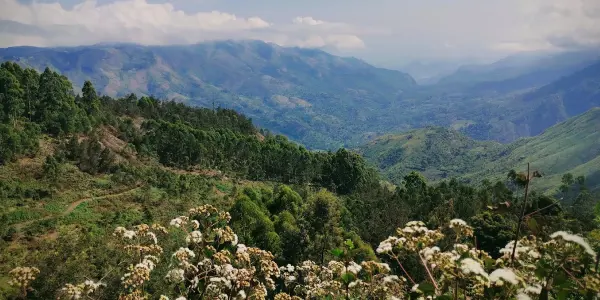
It is also home to the main temple of Murugan, which is worshipped as a significant deity in Tamil Nadu. It is surrounded by hills on all sides that climb out of our camping grounds. There are some lovely trekking trails within walking distance of our campus. One can hike to the summit of a nearby hill, watch the sunrise from behind the mounds, or take a dip in a nearby waterfall. You can also savor a cup of fresh coffee grown in the nearby plantations as you take a panoramic Elephant Valley view. History of Palani Hills Entry fee and timing Nearby place Location/how to reach STORY/HISTORY OF PALANI HILLS: The Palani Hills derive their name from the ancient temple town of Palani, located at the northern base of the hills. The Palani Hills are formed of pre-Cambrian gneisses, charnockites, and schists; they are among the oldest mountain ranges in India. The park is an eastward extension of the Western Ghats hills formed by separating the India-Madagascar-Seychelles blocks of East Gondwana in the Early Cretaceous period about 120 million years ago. Adventure lovers can explore more scenic trekking destinations in our Weekend Getaways From Bangalore guide.It is surrounded to the north, east, and south by the Deccan Plateau. It was formed in the massive Deccan Traps eruption 66 million years ago as India drifted over the Reunion Hotspot. In 1906, the tremendous undulating plateau on top of the Palanis comprising four forest ranges was consolidated under the Indian Forest Act and designated by the British Government as a single reserve forest from Kodaikanal town to the Kerala state border in the west and the Bodinayakkanur town limits to the south, and given the name of the Ampthill Downs. It was over 140 square kilometres (53 sq mi) in extent, and about one-quarter of it then consisted of sholas, and three-quarters were open, rolling, grassy downs. On 13 August 2012, in an apparent change away from plans for notification of parts of the Palani Hills as a separate wildlife sanctuary, the Tamil Nadu Gazette notification attached parts of Kodaikanal and Dindigul divisions of reserve forests to the buffer zone of Annamalai Tiger Reserve. About 5155.42 hectares of forest land belonging to Palani Hills Northern Slope, Andypatti reserve forest, 4,344.53 acres in Kudraiyar block forest, and 5,548.49 hectares in Mannavanur Range in Kodaikanal will be included in the buffer zone. The villages and hamlets that now form part of the Palani Hills buffer zone are Poondi, Munavvanur, Kilavarai, Polur, Kavunchi, Kumbur, Kilanavayal, Kukkal, Pazhamputhur and Puthurpuram. Looking for mountain escapes? Explore our Hill Stations Near Bangalore for Weekend blog.Eco-tourism's increasingly crucial economic role, including trekking, hiking, camping, mountaineering, rock climbing, and bird watching, may help the local populace welcome this new Protected area. It remains to be seen whether the Wildlife Sanctuary and National Park will stimulate or stifle commercial development and tourism. The decision to finally establish the park must balance the short-term financial benefits of the status quo versus the long-term stability of the natural and human community. The western extremity of the park is contiguous with the Manjampatti Valley core area of the Indira Gandhi Wildlife Sanctuary and National Park and with The Chinnar Wildlife Sanctuary in Kerala. The Kurinjimala Sanctuary in Kerala borders the southwestern corner of the park. These Wildlife Sanctuaries are adjacent to the recently established Eravikulam National Park. The park area includes only reserve forest land, including Palni Hills Northern Slope East, Kallar, Palni Hills Southern Slope East, Upper Palni Shola, Allinagaram, and Palni Hills Northern Slope West Reserve Forests in the Dindigul and Kodaikanal Forest Divisions. Rainforests give way to shola-grassland mosaic, made up of frost-tolerant montane grasslands interspersed with pockets of stunted shola forests. The hills extend into Kerala as Pampadum Shola National Park. Explore our Kodaikanal trekking package for scenic hikes, viewpoints, and nature experiences.ENTRY FEE AND TIME: For entry, there is no fee; for special darshan, it ranges from Rs 10 to Rs 300 Timing: 4:30 AM to 9:30 PM NEARBY LOCATIONS: Kodai Lake: Nestled in the heart of the Western Ghats, Kodaikanal is a charming hill station in Tamil Nadu, India, renowned for its picturesque landscapes and tranquil environment. At the centre of this idyllic town lies Kodai Lake, a stunning artificial reservoir that has become a focal point for visitors and locals alike. Dolphine Nose: An ideal spot for those interested in trekking, the trail to the Dolphin's Nose covers a distance of 3 km in the Palani Hill Range. This viewpoint is a favourite among the tourists who come to adore the glory of the Princess of Hill Stations. Devil's Kitchen: Guna Caves, initially named Devil's Kitchen, are notorious for their dangerous history, as many people who entered to explore them disappeared without a trace. As of 2016, police have recorded 16 disappearances in connection with the cave without bodies being retrieved. Pambar River: The Pambar River, located in southern India, is approximately 64 kilometres (about 40 miles) long. It originates from the Western Ghats, flowing through the Tamil Nadu state before merging with the Kottakudi River. Kurinji and Navara temple: Lord Murugan is the deity of the Kurinji region. The name Kurinji Andavar, which is used for Lord Murugan in the Kurinji Andavar Temple in Kodaikanal, symbolizes the connection between the hill region and the God of the hill. LOCATION/HOW TO REACH: Airway: Palani is located equidistant from Coimbatore; Trichy and Madurai Airports are nearby Railways: there are sufficient trains from Bangalore to Palani, which is the nearest railway station to PalaniPalani Hills